
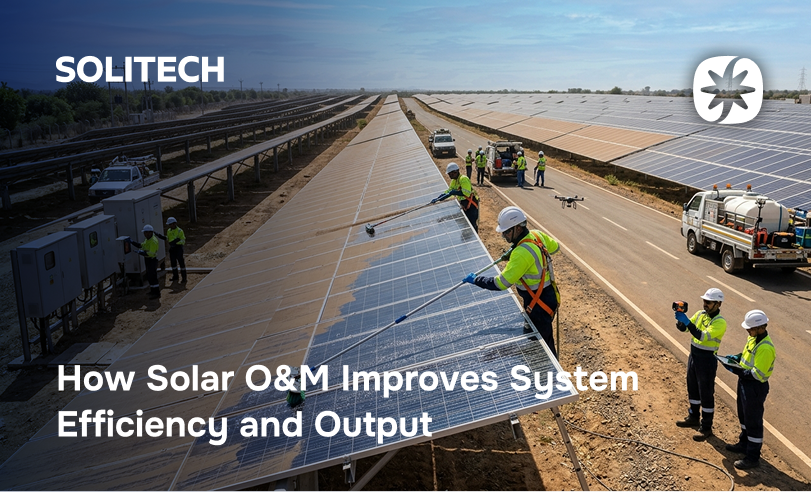
How Solar O&M Improves System Efficiency and Output

How Solar O&M Improves System Efficiency and Output-1

The Performance Gap No One Talks About

India’s solar sector is booming – with over 90 GW of installed capacity and a national target of 500 GW by 2030, solar power is now central to the country’s energy future. Businesses and industries are investing crores into solar installations expecting consistent returns over 25-30 years.

But here’s the uncomfortable truth: solar systems are not set-and-forget assets. Research across Indian climate zones shows that poorly maintained installations lose 15%-30% of their potential energy output every year. In dust-heavy regions like Gujarat, Rajasthan, and Maharashtra, the losses can be even steeper.
The good news? Most of this degradation is preventable through structured Solar Operations and Maintenance (O&M).

What Solar O&M Actually Means

Solar O&M covers two interconnected disciplines. Operations involves ongoing performance monitoring – tracking energy generation, detecting faults remotely, and managing system data. Maintenance involves physical interventions: cleaning panels, inspecting electrical systems, servicing inverters, and replacing degraded components

Together, they form a continuous cycle: monitoring identifies anomalies, maintenance corrects them, and the system returns to peak performance. Repeat this consistently over a plant’s lifetime, and you have a high-performing asset instead of a gradually failing one.

Why Solar Systems Lose Efficiency

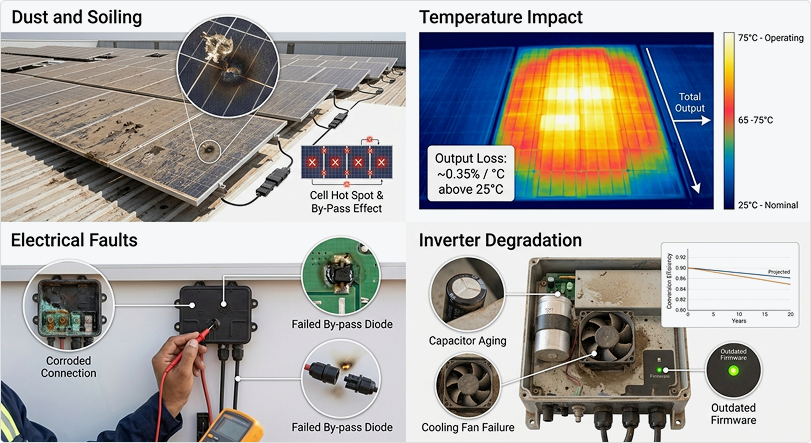
Dust and Soiling is the single biggest culprit in India. Dust, bird droppings, pollen, and industrial particulates block sunlight from reaching solar cells. Even partial soiling of a few cells can trigger bypass diodes and drag down an entire string’s output – what engineers call the “Christmas light effect.” Bird droppings are especially damaging, creating hot spots that can permanently scar individual cells.

Temperature is another major factor. Panels are rated at 25°C, but Indian summer conditions routinely push cell temperatures to 65-75°C. For standard crystalline silicon panels, every degree above 25°C cuts output by roughly 0.35%. At peak summer conditions, this alone can mean a 17-18% reduction in output.

Electrical faults – loose connectors, degraded cables, failed bypass diodes, corroded junction boxes – develop gradually and often go undetected without regular inspections. Studies show around 30% of commercial rooftop systems have electrical issues contributing 5-12% performance losses.

Inverter degradation quietly chips away at conversion efficiency. Capacitor aging, cooling fan failures, and outdated firmware all reduce inverter performance over time. A failing inverter can mean anything from a 1-2% efficiency drop to a complete system shutdown.

Why Solar Systems Lose Efficiency

How O&M Recovers Lost Output

Regular cleaning delivers the most immediate performance gains. For installations uncleaned for two to six months, post-cleaning generation increases of 15–25% are well-documented across Indian commercial sites. Professional O&M providers use deionized water, appropriate brushes, and trained technicians – not the abrasive methods that damage anti-reflective coatings over time.

Systematic inspections catch faults before they escalate. Tools like I-V curve tracers measure each string’s electrical performance against manufacturer specs. Thermal (infrared) cameras identify hot spots invisible to the naked eye. Together, these diagnostics pinpoint failing modules, loose connections, and overloaded components early.

Continuous monitoring is the backbone of effective O&M. Modern platforms track Performance Ratio (PR) – the ratio of actual output to theoretically possible output – at string and inverter levels in real time. A well-maintained system should maintain a PR of 80-85%. When PR drops, alarms trigger, and teams respond before losses accumulate.

Preventive maintenance – quarterly electrical checks, semi-annual thermographic surveys, annual comprehensive audits – keeps all components operating within spec and dramatically reduces the likelihood of costly unplanned failures.

The Financial Case

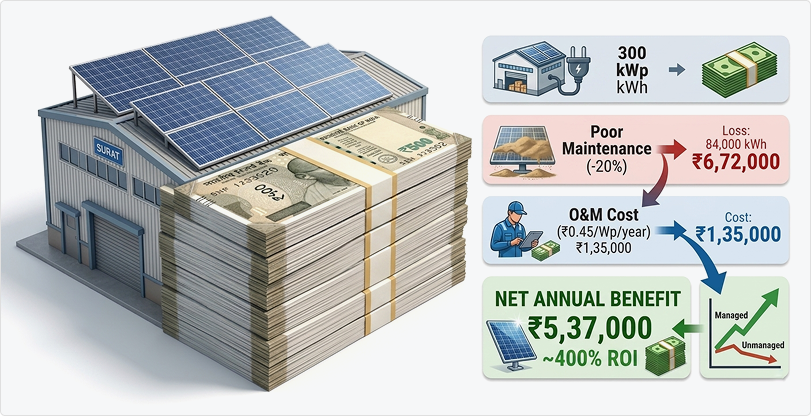
The numbers are straightforward. A 300 kWp industrial rooftop in Surat generating ~4,20,000 kWh annually saves roughly ₹33,60,000 per year at ₹8/kWh. A comprehensive O&M contract at ₹0.45/Wp/year costs approximately ₹1,35,000 annually.

If poor maintenance causes even a 20% performance deficit, the annual generation loss is 84,000 kWh – a financial hit of ₹6,72,000. Preventing this through professional O&M costs ₹1,35,000, delivering a net annual benefit of ₹5,37,000. That’s roughly a 400% return on the O&M investment – before accounting for prevented inverter failures, warranty preservation, and extended equipment lifespan.

Over a 25-year project life, the cumulative difference between a managed and unmanaged installation is enormous.

Conclusion: O&M Is Asset Management, Not an Expense

A solar installation is a long-lived productive asset. The difference between one that delivers on its financial promise and one that quietly underperforms for decades comes down to one decision: whether to maintain it professionally or not.

Solar O&M is not a cost – it is an investment that consistently returns three to five times its cost in recovered generation, prevented failures, and protected warranties. As India’s solar market matures, the businesses that treat O&M as integral to their solar strategy will be the ones that extract full value from their installations over the long term.

A solar panel installed but not maintained is a depreciating asset. Maintained professionally, it is a consistent, long-term return on capital.

Frequently Asked Questions

How often should solar panels be cleaned in India?

In high-dust areas like industrial Gujarat or Rajasthan, every 10-15 days during dry season (October-May). In moderate urban environments, monthly. In cleaner or coastal areas, quarterly. The most accurate approach: monitor your PR and clean when it drops 3-5% below your clean-panel baseline.

What Performance Ratio should a well-maintained system achieve?

Between 80% and 85%. Values consistently below 75% signal significant losses requiring investigation and corrective maintenance.

What does a professional O&M contract cost in India?

For 100 kWp-1 MWp commercial/industrial rooftop systems, typically ₹0.30-₹0.60 per Wp per year. The financial value of performance improvements delivered consistently exceeds this cost by a factor of three to five.

How do I know if my system is underperforming?

Watch for: generation below projected levels, declining PR, visible soiling or panel damage, inverter fault codes, or electricity bills higher than expected despite solar generation. String-level monitoring that shows one string significantly below others is a reliable early warning sign.

Does cleaning really make a measurable difference?

Yes – substantially. Field data across commercial installations in Gujarat, Rajasthan, and Maharashtra shows average post-cleaning generation increases of 15–25% for panels uncleaned for two to six months. Even on regular schedules, each cleaning cycle measurably maintains system performance closer to its potential.

What happens if maintenance is neglected for years?

Performance losses compound across soiling, electrical faults, and physical degradation. Systems can drop to 60-70% of rated capacity. Remediation is expensive, time-consuming, and some damage – cell cracks, severe delamination, badly corroded connections – may be irreversible. Remediation costs invariably exceed what systematic O&M would have cost.

Is O&M necessary for small 5–10 kWp installations?

Yes, proportionally. A 20% performance loss on a 5 kWp residential system means ~1,400 kWh/year in unrealized savings – ₹11,000–₹14,000 annually. Regular cleaning, monitoring app reviews, and an annual professional electrical inspection are practical and cost-effective at this scale.

What is PID and how does O&M address it?

Potential-Induced Degradation (PID) occurs when leakage currents between solar cells and grounded frames cause progressive performance loss – sometimes exceeding 50% in severely affected modules. It’s worsened by high humidity and poor earthing. O&M addresses it through regular earthing checks, insulation testing, monitoring for PID-characteristic performance patterns, and where needed, deploying PID recovery devices.

Solitech Solar is a leading solar panel manufacturer in India, offering advanced TOPCon and bifacial panels with 2.0 GW production capacity. Learn more at solitechsolar.com.

RELATED BLOG

From Rooftops to Solar Farms: Diverse Applications of Solar Energy

From Rooftops to Solar Farms: Diverse Applications of Solar Energy Home > Blog > From Rooftops to Solar Farms: Diverse Applications of Solar Energy Solar energy is rapidly transforming the way we power our lives. As the global shift towards renewable energy accelerates, solar power has emerged as a versatile and sustainable solution to meet […]

Read More...