What Actually Happens to Your Solar Panels During a Solar Eclipse?


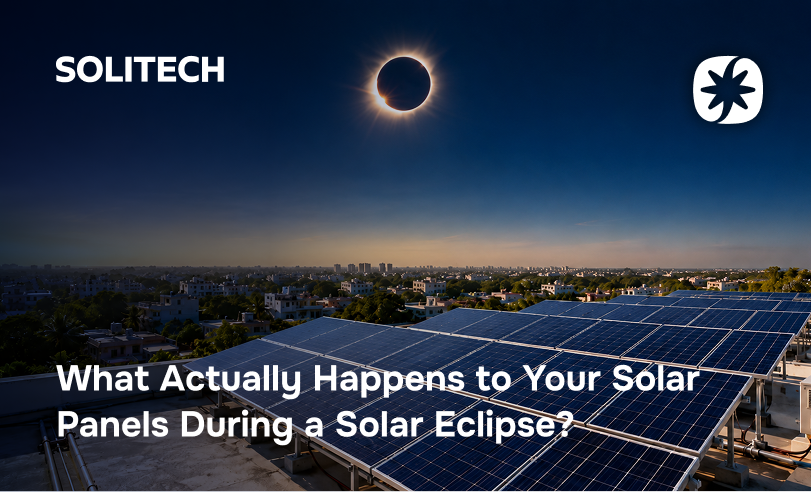
Imagine a clear afternoon in April. Your rooftop solar system is running at full capacity, the inverter looks healthy, and then – gradually – the sky begins to dim. Not clouds. Not dust. A solar eclipse is passing through, and within minutes your generation drops sharply.

Does your system stop working? Should you be worried?

The short answer is no. But what actually happens is genuinely fascinating.

How Solar Panels Work

Solar panels convert sunlight into electricity. More direct sunlight means more output. Reduce the sunlight, and generation falls proportionally – which is why panels produce less in the morning, less on cloudy days, and less in winter months.

An eclipse follows the same principle. It just does it faster and more dramatically than any cloud ever would.

What an Eclipse Does to Your System

During a partial eclipse, the moon covers only a portion of the sun. Irradiance drops but doesn’t disappear. Panels keep generating – just at reduced output. Depending on coverage, generation might fall 30, 50, or even 70 percent at peak.

During a total eclipse, the moon completely blocks the sun along a narrow path. Systems directly in that path see irradiance drop to near zero for a brief period – sometimes just two to three minutes. Systems outside the totality path experience a partial effect.

The critical word in both cases is temporary.

How Fast Does It Drop and Recover?

Unlike seasonal changes, a solar eclipse creates a sharp, fast, predictable dip. Output can fall significantly within fifteen to thirty minutes and recover at a similar pace. The full event spans one to three hours. Maximum impact lasts far less.

On your monitoring app, it shows as a clean valley on the generation graph – a sharp drop followed by a full recovery. Nothing alarming. Just physics doing its thing.

What Happens at the Grid Level?

For individual rooftop systems, an eclipse is a temporary inconvenience. For large-scale grids with significant solar capacity, it becomes a real operational event.

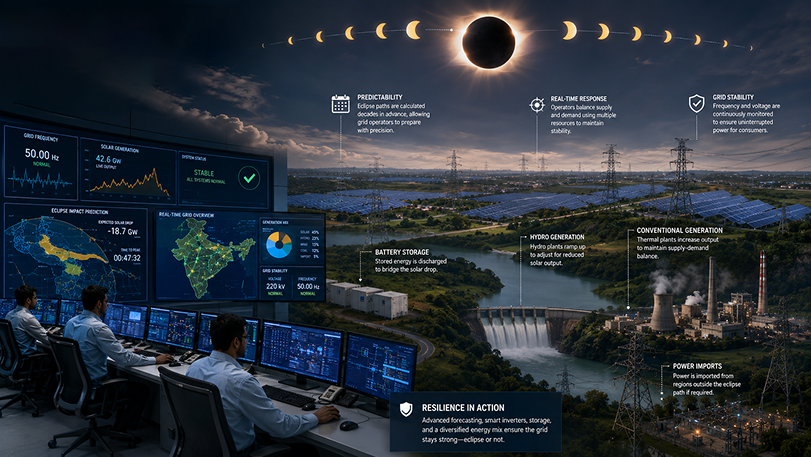
When thousands of installations simultaneously reduce output, grid operators need to compensate – drawing on stored energy, ramping up hydro or conventional generation, or importing from regions outside the eclipse path. Grid frequency and voltage must remain stable throughout.

The key advantage eclipses have over other disruptions is predictability. Astronomers calculate eclipse paths decades ahead. Grid operators know exactly when it will happen, which regions are affected, and how severe the drop will be. That predictability makes preparation manageable.

Modern grids handle this through battery storage, smart inverters, and sophisticated forecasting systems. Every eclipse that passes without disruption is evidence that solar infrastructure is more resilient than many assume.

The Indian Context

India’s solar capacity has expanded significantly – utility-scale plants across Rajasthan, Gujarat, Tamil Nadu, and Andhra Pradesh, alongside millions of rooftop systems. As solar contributes a growing share of national electricity, eclipse preparedness has become a genuine consideration for grid operators at NLDC and state load despatch centres.

India has seen several notable eclipses in recent years. Grid managers have treated these as practical exercises in real-time solar management. Battery storage capacity – still expanding across India’s grid – plays an increasingly important role in smoothing these fluctuations.

For residential owners, the impact is minimal. Your system generates less during the eclipse. Your home draws more from the grid or batteries. When it passes, generation returns to normal. Monthly figures barely register it.

What Eclipses Teach Solar Engineers

There’s a benefit to eclipses that rarely gets discussed. They serve as natural stress tests for solar infrastructure. Researchers use them to study how panels and inverters respond to rapid irradiance changes – improving forecasting algorithms, inverter response systems, and grid balancing strategies in ways controlled testing simply cannot replicate.

The eclipse becomes an unplanned but valuable real-world laboratory.

Conclusion

For your solar panels, a solar eclipse is a temporary dip in an otherwise long and productive operational life. Modern systems, smart inverters, and capable grids handle these events with minimal disruption to consumers.

The occasional dimming of the sun for a few minutes doesn’t change the fundamental case for solar. Designed and managed well, solar energy remains one of the most reliable long-term power investments available – eclipse or not.

Frequently Asked Questions

Do solar panels completely stop during an eclipse?

During a partial eclipse, panels keep generating at reduced output. During a total eclipse, systems in the path of totality produce near zero briefly before fully recovering.

How much does an eclipse affect annual generation?

Minimally. Even a significant eclipse affects generation for a few hours at most. Annual impact is typically under 0.1 percent – essentially negligible over the system’s lifetime.

Should I do anything special during an eclipse?

Nothing. Output drops temporarily and recovers fully on its own. No intervention is needed from the system owner.

How do grid operators manage the generation drop?

Through advance forecasting, battery storage, flexible conventional generation, and real-time monitoring. Predictability makes preparation straightforward compared to unplanned disruptions.

Does battery storage help during an eclipse?

Yes. Homes and businesses with storage can draw from batteries during reduced generation, minimising any impact on consumption.

How quickly does generation recover?

Recovery begins as the moon moves away. Full recovery to normal output typically happens within thirty to sixty minutes of peak coverage passing.

Are large solar plants more affected than rooftop systems?

The proportional impact per system is similar. The grid-level challenge is larger because thousands of installations reduce output simultaneously.

Do eclipses damage solar panels?

No. An eclipse causes no physical stress, thermal damage, or lasting effect on panel performance or lifespan.

RELATED BLOG

Why Surat’s Top Industrialists Are Resigning from the Grid This April (The Solitech Solar Power Revolution)

Why Surat’s Top Industrialists Are Resigning from the Grid This April (The Solitech Solar Power Revolution)

For years, solar was treated like a “nice‑to‑have” add‑on—just another line on the expense sheet, not something that could actually change the way a business runs. But in 2026, something has quietly shifted. Today, solar isn’t just saving money; for many homes and factories, it’s turning into a real‑life pocket machine, quietly working in the background and paying back every single day.

Read More...
How Solitech’s Hydrophobic Coating Saves You Thousands in Cleaning Costs

How Solitech’s Hydrophobic Coating Saves You Thousands in Cleaning Costs?

It is said that when it comes to making important decisions in life, you should make them now because a good opportunity doesn’t come around again. Last month, when the Solitech Solar team was on a site visit, they saw people cleaning the panels by climbing very high, that is on top of the solar panels. There was a risk of slipping while doing this work. Those people were unfortunate that they did not order solar from Solitech Solar. We provide special hydrophobic coating panels. This automatically cleans the dirt or dust on your panels. People are installing solar panels in large numbers, the main purpose of which is to eliminate the cost of electricity bills. You must have heard many times that something that benefits us also has disadvantages. One such disadvantage is the dust that remains on the solar panels after they are installed. Solitech Solar has received many customer questions that when we clean solar panels, water or dust remains on them, which reduces their efficiency. That’s why we have brought you special hydrophobic coating panels.

Read More...
How Solitech Solar Ensures You Stay 100% Compliant with New Environmental Laws

How Solitech Solar Ensures You Stay 100% Compliant with New Environmental Laws

Everything on earth, whether it is an electronic thing or any other thing, is certain to be destroyed. But it is very important to manage the thing once used so that no problem related to the environment arises. This applies when it comes to solar panels. Friends, solar panels give us the joy of uninterrupted energy for 25 years. After such a long time, when the efficiency of the panel decreases, it is necessary to manage it. The government is also taking steps in this regard, so the government has implemented many rules so that there is no harm to the environment. In 2026, this question is not just about the environment, but about the law. The Indian government has implemented very strict E-Waste Management Rules for the disposal of solar panels.

Read More...