
Why Dirty Solar Panels Are Silently Draining Your Energy - And What to Do About It


You invested in solar to save money and cut dependence on the grid. But here’s something most people overlook: the moment your panels go up on the roof, they start collecting more than just sunlight.

Dust. Bird droppings. Tree pollen. Industrial soot. Post-monsoon film. All of it quietly chips away at your energy output.

The good news? It’s one of the easiest problems to fix.

How Dirt Directly Affects Your Energy Output

Solar panels work on a simple principle – sunlight hits the photovoltaic cells and electricity is generated. Anything blocking that sunlight disrupts the process.

Even a thin layer of dust can reduce efficiency by 15-25%. What most people don’t realize is that panels are wired in series. If one section is covered with grime, it drags down the output of the entire string. A patch of bird droppings in the wrong spot can behave like a permanent shadow over your whole system.

Why Indian Conditions Make Cleaning Even More Critical

Solar owners in India face a uniquely tough environment. Here’s what your panels deal with daily:

Dust and dry spells

In Rajasthan, Gujarat, and Maharashtra, months of dry weather mean panels accumulate thick layers of fine dust quickly.

Urban air pollution

In metro cities and industrial corridors, vehicle emissions coat panels with a greasy film that light rain can’t remove.

Bird droppings

Pigeons and crows love rooftop installations. Their droppings are mildly acidic and can etch into panel surfaces if left untreated for weeks.

Coastal salt exposure

In cities like Mumbai, Chennai, or Kochi, salt-laden air deposits a mineral film that hardens over time and is harder to clean than ordinary dust.

Post-monsoon residue

Rain carries pollutants and leaves muddy residue as it evaporates. After every monsoon, a cleaning round is essential.

Signs Your Panels Need Cleaning

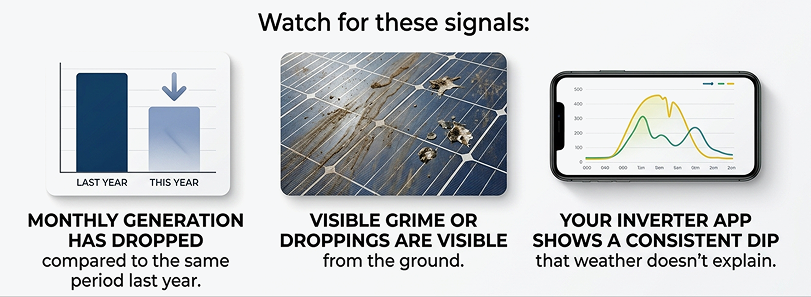
Watch for these signals: monthly generation has dropped compared to the same period last year, visible grime or droppings are visible from the ground, or your inverter app shows a consistent dip that weather doesn’t explain. If it’s been over 6-8 weeks since your last clean, that’s enough reason to act.

watch-for-this-signals

Best Practices for Safe, Effective Cleaning

Time it right.

Never clean under direct afternoon sun. Hot glass and cold water can cause micro-cracks. Early morning is ideal – panels are cool and overnight dew helps loosen dust.

Use the right tools.

Plain water and a soft cloth handle routine cleaning. For stubborn grime, a few drops of mild dish soap works well. Use a soft-bristled brush with a long handle to reach panels safely. Avoid abrasive scrubbers or chemical cleaners—they scratch the glass and permanently reduce light transmission.

Rinse thoroughly.

Soap residue left behind attracts dust faster and leaves streaks. Always finish with a clean water rinse.

Clean the frames too.

Dirt collects heavily in the metal borders around each panel. A quick wipe prevents moisture buildup and keeps the structure sound.

Common Mistakes to Avoid

Using hard water

Mineral-rich tap water leaves calcium deposits on the glass. Use RO-filtered water for the final rinse if your tap water is hard.

Pressure washing

High-pressure jets damage panel seals and push water into junction boxes. Stick to a low-pressure garden hose.

Skipping safety measures

Falls are the biggest hazard in DIY panel cleaning. If your roof is steep or panels are hard to reach, hire a professional.

Cleaning too infrequently

Once a year isn’t enough in India. Quarterly is the minimum in dusty areas; monthly is standard for industrial systems in peak summer.

How Often Should You Clean?

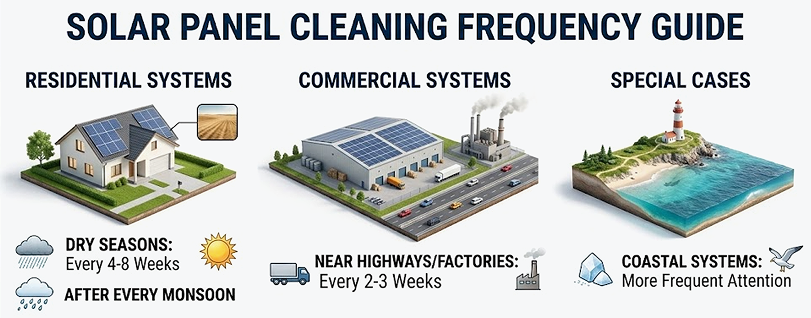
Residential systems generally need cleaning every 4-8 weeks during dry seasons and after every monsoon. Commercial systems near highways or factories may need cleaning every 2-3 weeks. Coastal systems need more frequent attention. When in doubt, track your generation data – the numbers will tell you.

How Often Should You Clean

The Long-Term Payoff

Over a 25-year lifespan, consistently clean panels generate meaningfully more electricity – directly protecting your return on investment. Regular cleaning also helps catch problems early: cracked panels, loose mounts, or water near junction boxes are cheap to fix now and expensive later.

At Solitech Solar, we know quality installation is just the foundation. Consistent maintenance is what makes your investment deliver for decades.

Frequently Asked Questions

How often should solar panels be cleaned?

Every 4-8 weeks during dry seasons for most Indian homes. Always clean after the monsoon. Dusty or industrial locations may need more frequent cleaning.

Can rain clean solar panels effectively?

Rarely. Rainwater carries pollutants that leave residue as it dries. Manual cleaning is still needed even after heavy rain. 

Is it safe to clean solar panels yourself?

Yes, for accessible rooftops with basic precautions – early morning, proper footwear, no overreaching. For steep roofs, hire a professional.

Does dirt significantly reduce efficiency?

Yes. A light dust layer can cut output by 15-20%. Concentrated soiling like bird droppings causes sharper drops due to how panels are wired.

What cleaning products should be avoided?

Abrasive scrubbers, acidic cleaners, and solvents. They damage the anti-reflective coating and frame seals. Mild soap and clean water is almost always sufficient.

Regular solar panel maintenance isn’t a chore – it’s how you protect the investment you’ve already made. Clean panels, monitored consistently, will keep delivering reliable performance for the long haul.

RELATED BLOG

Why Solitech-Powered Assets Command a 15% Premium in 2026 Real Estate Appraisals

Why Solitech-Powered Assets Command a 15% Premium in 2026 Real Estate Appraisals

A few years ago, people believed that solar power was just a means to reduce electricity bills, but today, solar is an important device that increases the value of your property. Suppose you have bought 2 flats worth Rs 1 crore each. One of them is a normal house but the other house has a high-profile solar system from Solitech Solar installed. The value of both these types of properties will not remain the same in 2026 and in the coming years. Why do bank valuers give a premium of 10 to 15% on solar homes in the market? This remains an important question. That is what we want to talk about in this blog. Many people still live under the burden of electricity bills because they don’t know the real value of solar. We are confident that after reading this blog, you will know that solar is not only enough to reduce electricity bills to zero but also increases property asset value in the market.

Read More...
Top 10 Solar Manufacturing Companies in India in 2026

Top 10 Solar Manufacturing Companies in India in 2026

India is racing toward its ambitious renewable energy goals, and solar manufacturing is right at the heart of that journey. With the government pushing for domestic production and global demand for clean energy soaring, Indian solar manufacturers have stepped up in a big way.

Read More...