SoliFusion – The Ultimate Bi-Facial Advantage!
An unexpected revolution is about to happen in the solar sector in the next 5 years, and it is almost here. Solitech is also not forgetting to keep walking with it.
Put two 600 Wp modules side by side on a datasheet and they look identical. Put them on the same roof for a year and the meter can tell a different story. The gap is small each day, but over the years it adds up. Here is where it comes from, and what Solitech Solar publishes on its datasheets so buyers can compare.
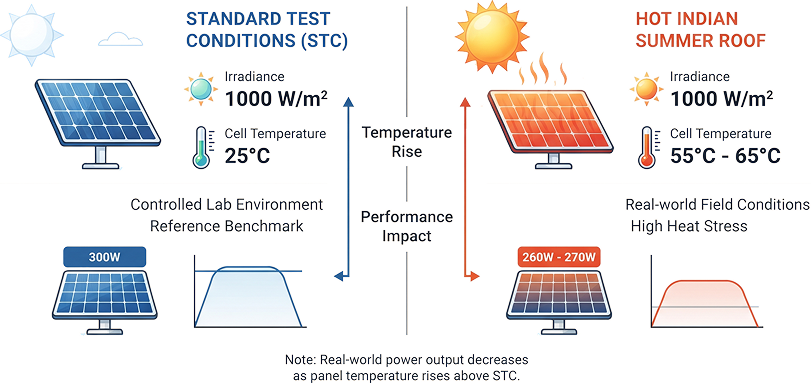
Rated power is measured under Standard Test Conditions: 1000 W/m2 of sunlight and a cell temperature of 25°C. Your roof never behaves like that. In an Indian summer, cells commonly run 20 to 30°C hotter than the air, so real output depends on how a module handles heat, not just on the number on the sticker.
Every module loses power as it heats up, and the temperature coefficient says how much per degree. It varies by model, so use the exact figure from each datasheet. Solitech Solar’s SoliFusion lists a power temperature coefficient of -0.29%/°C. With cells at 55°C, which is 30°C above the test condition, that is a loss of about 8.7%. A module rated at -0.35%/°C would lose about 10.5% under the same conditions.
Two modules that start equal will not necessarily stay equal. How much power a module retains depends on its first-year and annual degradation specifications, and these differ between products. Solitech Solar’s SoliFusion datasheet lists degradation of under 1.0% in the first year and under 0.4% per year from years 2 to 30, with a linear performance graph that ends at 87.5% in year 30. Compare both figures, and the warranty terms, rather than assuming equal wattage means equal ageing.
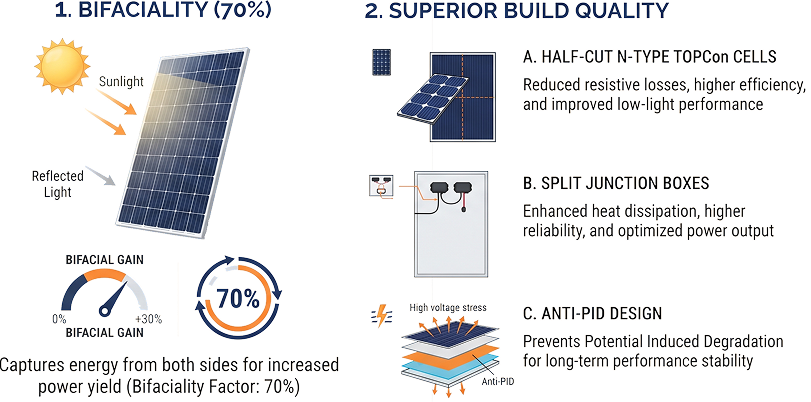
A bifacial module also collects light on its rear side. The SoliFusion datasheet lists a bifaciality factor of 70 ± 5%, and notes that the actual rear gain depends on mounting height, tilt and ground reflectivity. Build matters too: half-cut N-type TOPCon cells, split junction boxes with bypass diodes and anti-PID design help a module cope with heat, shade and mismatch.
Look past the headline wattage. Compare the temperature coefficient of Pmax, first-year and annual degradation, bifaciality factor, power tolerance and the warranty terms. When you shortlist a brand such as Solitech Solar, ask for the datasheet and compare it line by line.
Solitech Solar is a Gujarat-based module manufacturer with 2 GW of production capacity, specialising in N-Type TOPCon modules. Its manufacturing is automated and integrated with ERP and MES systems for traceability, and its modules are ALMM enlisted and BIS certified. For the SoliFusion, Solitech lists a 30-year linear performance warranty and a 12-year product workmanship warranty, with full terms in its warranty document. Solitech makes modules, so tilt, spacing and cleaning stay with your installer or EPC partner, but the starting point is a module with published, comparable specifications.
Wattage tells you what a module can do for an hour in a lab. Temperature behaviour, degradation specifications and build quality tell you what it can do over its life on your roof. Compare those lines, not just the watts. To explore the range, speak with the Solitech Solar team.
Solitech is a Gujarat-based manufacturer with 2 GW capacity, ALMM enlisted and BIS certified modules and ERP and MES integrated production.
Yes. Solitech makes N-Type TOPCon modules, including bifacial options like the SoliFusion.
The SoliFusion lists a 30-year linear performance warranty and a 12-year product warranty. Check the warranty document for terms.
Yes. They are ALMM enlisted and BIS certified, but eligibility for a project depends on the applicable scheme and its requirements.
No. Solitech manufactures modules. Installation is handled by installers and EPC partners.

An unexpected revolution is about to happen in the solar sector in the next 5 years, and it is almost here. Solitech is also not forgetting to keep walking with it.

The demand for solar energy is increasing worldwide and a large number of people are becoming aware of it. So it is natural that due to this response, the latest technology comes into the solar sector. TOPCon solar panels are one of them.
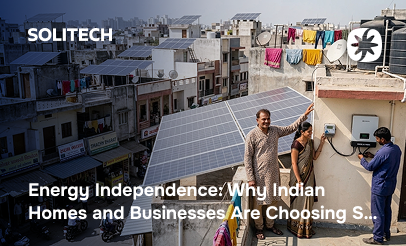
Ten years ago, when a homeowner in Gujarat mentioned solar panels, neighbors asked, “How much will that save on my electricity bill?” Today, the conversation has shifted dramatically. The question is no longer just about savings – it’s about control. Control over your energy source, your costs, and your resilience when the grid falters.
Developed By: Littlebig.in