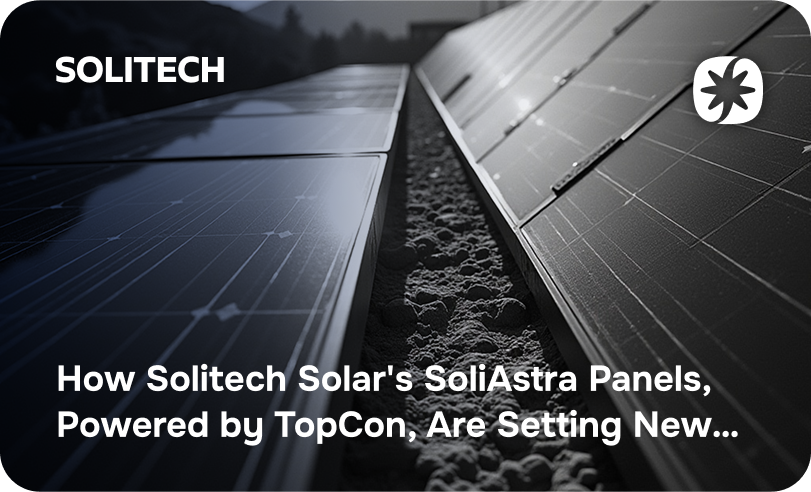
How Solitech Solar's SoliAstra Panels, Powered by TopCon, Are Setting New Standards in Efficiency

blog4-image

Imagine a world where every rooftop, every open field, every industrial space pulses with the clean, abundant energy of the sun. At Solitech Solar, this vision isn’t just a dream; it’s the driving force behind our relentless pursuit of innovation. Today, we’re unveiling the transformative power of TopCon technology, the heart of our SoliAstra panels, and how it’s reshaping the very landscape of solar energy.

You’ve heard of solar panels, but have you heard of TopCon? Think of it as the secret ingredient that turbocharges solar efficiency. While conventional panels lose precious energy in the conversion process, TopCon, or Tunnel Oxide Passivated Contact, technology acts like a meticulously engineered highway for electrons. It introduces an ultra-thin oxide layer and a highly doped polysilicon layer, effectively minimizing energy roadblocks and maximizing the flow of power. It’s like upgrading from a bumpy dirt road to a smooth, high-speed freeway for solar energy.

At Solitech Solar, we don’t just manufacture solar panels; we craft the future of energy. Our 2.0 GW production capacity, coupled with cutting-edge ERP and MES systems, ensures that every SoliAstra panel embodies precision, quality, and unwavering reliability. We adhere to the most rigorous international standards, because we believe that excellence is the only standard worth pursuing.

The future of energy is here, and it’s powered by TopCon. SoliAstra panels are not just a product; they’re a testament to our unwavering commitment to innovation, sustainability, and a brighter tomorrow.

Related Blog

PM Surya Sarovar Yojana 2026 What India New Floating Solar Mission Means for Solitech Solar-featured

PM Surya Sarovar Yojana 2026: What India’s New Floating Solar Mission Means for Solitech Solar

On August 1, 2026, the Union Cabinet led by Prime Minister Narendra Modi approved the Pradhan Mantri Surya Sarovar Yojana (PM-SSY), a scheme dedicated to floating solar power. The mission aims to develop 5,000 MW of floating solar capacity along with 10,000 MWh of co-located energy storage, backed by an outlay of Rs 5,070 crore. Some of the key highlights include:

Read More...