


When Quality Becomes the New Currency: Solitech Solar and the ALMM 2026 Shift

When Quality Becomes the New Currency Solitech Solar and the ALMM 2026 Shift-1


There’s a quiet but significant change happening across India’s solar industry – and it doesn’t show up loudly in headlines. It shows up when a commercial buyer starts asking for module datasheets before asking for price. It shows up when a factory owner in Surat or a housing society in Pune calls a manufacturer not to negotiate a discount, but to ask how long the panels will actually last.

India’s solar market is growing up. And ALMM 2026 is one of the clearest signals of that maturation.

Beyond the Price Race

For most of the last decade, solar adoption in India was driven by one overwhelming question: how cheap can we go? That pressure wasn’t unreasonable – it helped make solar financially viable at a scale once unimaginable. But hard lessons have followed. Projects built around the cheapest available modules have, in some cases, delivered disappointing generation numbers years later. Degradation rates that weren’t scrutinized at purchase are now being felt. Warranties that looked good on paper have run into manufacturers who no longer exist.

The market is correcting. Buyers are increasingly asking different questions – not just “what’s the price per watt?” but “who made this, how, and will they still be around in fifteen years?”

What ALMM Actually Represents

The Approved List of Models and Manufacturers is often described in regulatory terms, which makes it easy to miss what it signals at the industry level. Being listed under ALMM means a manufacturer’s modules have been reviewed and approved for use in government-backed solar projects. But that framing undersells what the list has become.

ALMM 2026 is less a compliance checkbox and more a reflection of where industry expectations have landed. The manufacturers on the list aren’t just those with the largest production lines – they’re those who demonstrate consistent quality, appropriate certifications, and the technical credibility to supply modules that meet India’s evolving standards.

For buyers evaluating manufacturers – whether for a rooftop commercial project or a large industrial installation – ALMM listing has started functioning as a meaningful filter. Not the only filter, but a real one.

The Technology Shift Happening Right Now

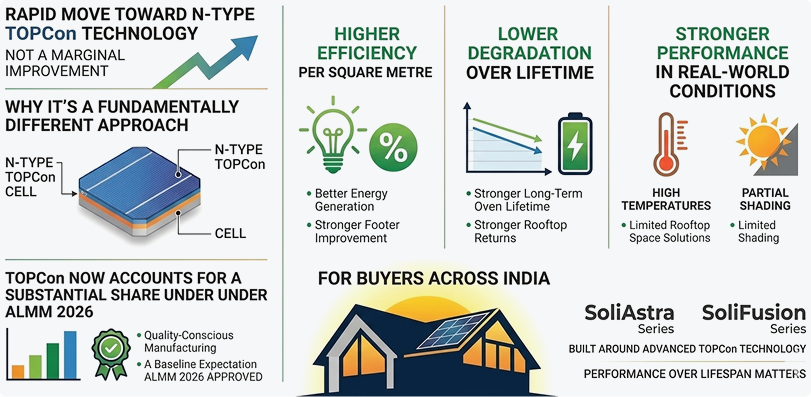
One of the more telling aspects of the current manufacturing landscape is the rapid move toward N-Type TOPCon technology. This isn’t a marginal improvement – it represents a fundamentally different approach to how solar cells perform over time.

TOPCon modules deliver higher efficiency per square metre, lower degradation over the module’s lifetime, and stronger performance in real-world conditions including high temperatures and partial shading. For buyers across India – where rooftop space is often limited and summer temperatures regularly test equipment limits – these characteristics translate directly into better energy generation and stronger long-term returns.

Solitech Solar’s product line, including the SoliAstra and SoliFusion series, is built around advanced TOPCon technology precisely because performance over the system’s lifespan matters more than an impressive spec sheet at the point of sale. The fact that TOPCon now accounts for a substantial share of newly approved modules under ALMM 2026 tells you something important: quality-conscious manufacturing has moved from being a differentiator to being a baseline expectation.

The Technology Shift Happening Right Now

Scale and Quality Must Move Together

There was a period when manufacturing capacity numbers dominated industry conversations. Capacity matters, genuinely – it speaks to investment commitment and supply reliability. But scale without quality control is a liability. A factory that produces millions of modules annually but cannot consistently hold tight tolerances on efficiency and power output isn’t actually delivering on its promise.

What ALMM 2026 nudges the industry toward is a pairing: genuine manufacturing scale supported by verifiable quality systems. Certifications like IS 14286 and ISO 9001:2015 – both held by Solitech Solar – aren’t decorative. They represent documented processes ensuring what comes off the line matches what was promised on the datasheet.

With a 2 GW production capacity and a manufacturing foundation built around certified quality standards, Solitech Solar represents the kind of domestic manufacturer that ALMM 2026 is designed to validate and support.

What Customers Are Actually Starting to Ask

The shift in buyer behaviour is tangible. Commercial and industrial buyers are asking about ALMM status, certifications, efficiency warranties, and post-sales support before signing purchase orders. Homeowners are more informed than they were five years ago – online communities and advisory platforms have made buyers aware that a twenty-five-year promise deserves serious scrutiny upfront.

Reliability, in short, has started to carry real commercial weight.

The Road Ahead

ALMM 2026 alone won’t resolve every quality challenge in India’s solar industry. But it is part of a directional shift where manufacturing credibility, product consistency, and long-term performance are increasingly treated as non-negotiable. The manufacturers who will lead India’s solar story over the next decade are those who understand that volume and quality are not trade-offs to be managed, but complementary strengths built together.

For anyone buying solar today – whether a single rooftop or a multi-megawatt industrial project – the questions worth asking have grown more sophisticated. That’s a sign of an industry finally building for the long term.

Frequently Asked Questions

What is ALMM and why does it matter in 2026?

ALMM is India’s Approved List of Models and Manufacturers – a government-maintained list of solar modules approved for use in government-linked projects. In 2026, it has become a meaningful quality signal for buyers across all segments.

Is ALMM listing only relevant for government projects?

Formally yes, but many commercial and industrial buyers now use ALMM status as a credibility filter since it reflects a manufacturer’s ability to meet documented quality and compliance benchmarks.

Why is TOPCon becoming the standard technology?

N-Type TOPCon cells deliver higher efficiency, lower degradation, and better real-world performance than older P-Type cells. As buyers have grown more performance-aware, TOPCon has shifted from a premium option to an industry expectation.

What certifications should a reliable manufacturer hold?

Look for IS 14286, relevant IEC standards, and ISO 9001:2015. These indicate that a manufacturer’s processes and products have been independently verified for quality and consistency.

How does manufacturing quality affect long-term solar performance?

Solar systems run for 25 years or more. Inconsistent quality leads to faster degradation, lower energy generation than projected, and warranty complications. Quality manufacturing directly determines how a system performs over its entire life.

What should buyers look for beyond price?

ALMM listing, certifications, module efficiency, degradation warranties, and post-sales support. Total cost of ownership over the system’s life is a more useful metric than upfront cost alone.

How does Solitech Solar align with ALMM 2026 expectations?

Solitech Solar manufactures advanced TOPCon modules – SoliAstra and SoliFusion – with IS 14286 and ISO 9001:2015 certifications, backed by a 2 GW production capacity. This combination of technology, scale, and verified quality is exactly what ALMM 2026 reflects as the new industry standard.

Will solar quality standards continue rising beyond 2026?

Almost certainly. As India’s renewable targets grow and the installed base matures, both regulators and buyers will raise performance expectations. Manufacturers investing in quality systems and advanced technology now will be best positioned for what comes next.

RELATED BLOG

Why April 1st is the Most Profitable Day to Sign Your Solitech Solar Contract

Why April 1st is the Most Profitable Day to Sign Your Solitech Solar Contract

The month of April has arrived, if you still haven’t installed solar, then you are making a big mistake. Half a year has passed and you still haven’t realized that this is the right time to install solar. While people will be busy making April Fools’ jokes this April, you are also saving lakhs of rupees by installing solar in your home or industry. April 1st is the day to start a new fiscal year. If you join hands with Solitech Solar today, you are not only saving electricity, you are Secure your taxes and profits. People are renovating their homes in large numbers today, but they are making one big mistake: they are not installing solar.

Read More...