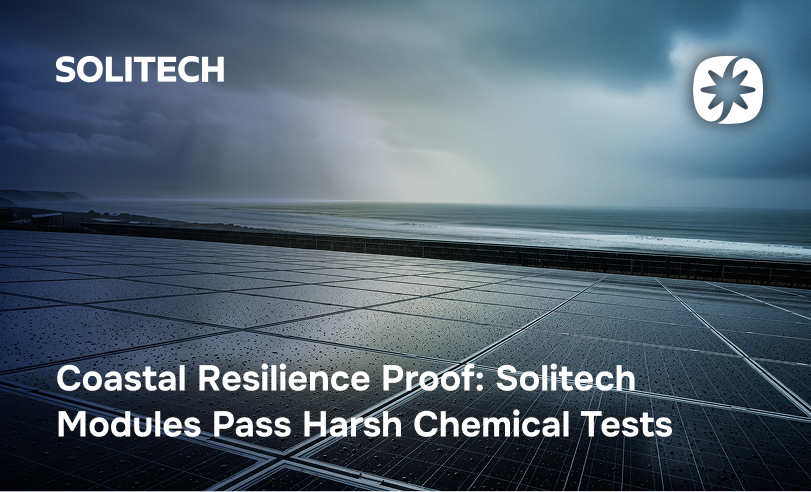

Coastal Resilience Proof: Solitech Modules Pass Harsh Chemical Tests

Coastal Resilience Proof Solitech Modules Pass Harsh Chemical Tests

As the adoption of solar energy grows worldwide, it has become essential to ensure that solar panels perform efficiently across all environmental conditions.

For coastal regions like Surat, Jamnagar, and Bhavnagar, solar installations face more than just sunlight exposure. High salt content, moisture, and chemical pollutants can severely impact the durability and output of conventional panels.

With Solitech Solar, you don’t have to worry. Every module is engineered and tested to withstand the most challenging environmental and chemical conditions.

1) Salt Mist Corrosion Test

Solar panels installed in coastal zones are constantly exposed to salty air and moisture. These elements can corrode metal components, damage connectors, and reduce long-term efficiency.

Solitech Solar modules undergo Salt Mist Corrosion Testing (IEC 61701) to ensure strong resistance against coastal environmental stress.

Result → Long-lasting durability with no significant performance loss.

2) Ammonia Corrosion Test

Agricultural and livestock areas release ammonia from organic waste, which can chemically attack solar panel surfaces and frames.

To protect your investment, Solitech Solar conducts Ammonia Corrosion Testing (IEC 62716) so that panels installed near farms remain stable, efficient, and corrosion-free.

3) Dual-Glass & Anti-Corrosion Technology

Solitech’s dual-glass module design, combined with anti-corrosion materials, provides superior protection against:

This ensures consistent power production and long operational life—even in the toughest environments.

360-Degree Protection, Only With Solitech Solar Panel Modules

Solitech Solar’s successful completion of stringent chemical resistance tests guarantees:

We protect your investment, and we ensure your solar system performs safely and efficiently—no matter where it is installed.

Related Blog

The June 2026 Deadline Why Non-DCR Panels Could Void Your Industrial Subsidy and Grid Approval

The June 2026 Deadline: Why Non-DCR Panels Could Void Your Industrial Subsidy and Grid Approval

2026 has arrived. If you are also thinking of installing solar in 2026, whether for business or in industry, then make a special note of June 1, 2026. Many rules are changing on industrial solar. According to the new rules of the Government of India, all the devices connected to the grid are going to be changed. Many customers get cheated when they plan to install solar because the company doesn’t deliver as promised. Many solar companies show high-quality panels and sell very low-quality and cheap panels. In one way, industrial solar needs more kilowatts. This year, if your panels are not made in India, you may lose lakhs of subsidy for your business. This is something to keep in mind. It is also possible that the DISCOM may not give permission at all. Today we will discuss this serious topic in detail:

Read More...
How Solar O&M Improves System Efficiency and Output

How Solar O&M Improves System Efficiency and Output

India’s solar sector is booming – with over 90 GW of installed capacity and a national target of 500 GW by 2030, solar power is now central to the country’s energy future. Businesses and industries are investing crores into solar installations expecting consistent returns over 25–30 years.

Read More...