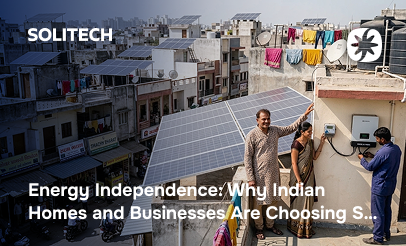
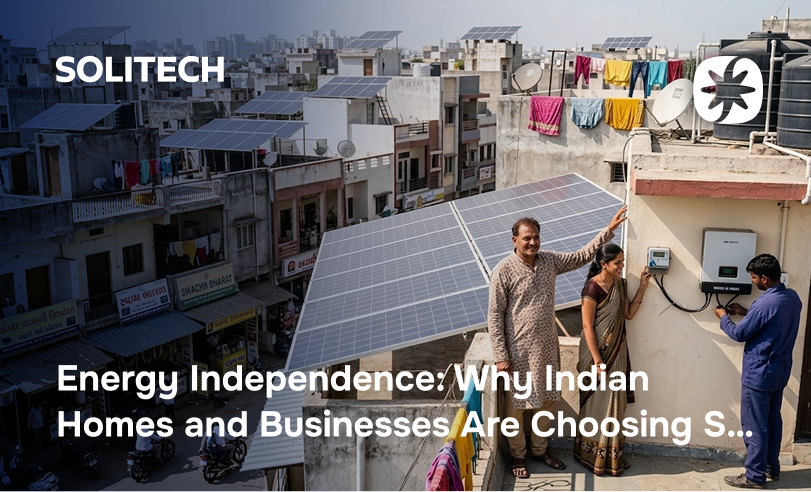
Energy Independence: Why Indian Homes and Businesses Are Choosing Solar Now

Energy Independence Why Indian Homes and Businesses Are Choosing Solar Now-main


Ten years ago, when a homeowner in Gujarat mentioned solar panels, neighbors asked, “How much will that save on my electricity bill?” Today, the conversation has shifted dramatically. The question is no longer just about savings – it’s about control. Control over your energy source, your costs, and your resilience when the grid falters.

At Solitech Solar, we’ve watched this transformation unfold across homes and factories from Surat to Hyderabad. Energy independence has become the real driver behind India’s rooftop solar boom.

What Does Energy Independence Really Mean Today?

Energy independence isn’t about completely disconnecting from the grid. It means generating enough electricity on-site through rooftop solar and storage to significantly reduce reliance on external power sources. For Indian households and businesses, it translates to:

As India’s electricity demand is expected to double by 2040 due to urbanization and industrial expansion, this shift toward self-generation is becoming strategic, not just economical.

Why Energy Dependence Is Becoming a Growing Concern

Rising Electricity Tariffs Hit Hard

Residential and commercial electricity rates across India have been climbing almost every year. In many states, tariffs have increased 5-8% annually. For a business running machinery 12 hours daily or a home with multiple air conditioners during longer summers, these hikes stack up quickly.

Solar gives you free electricity for 25+ years once the system is installed, insulating you from future tariff shocks.

Peak-Hour Shortages and Grid Stress

Peak-Hour Shortages and Grid Stress

Power cuts are especially common during India’s hottest summer months when cooling demand peaks. Urban and industrial areas face strain as the grid struggles to meet load requirements.

A textile factory in Surat might lose production hours during an afternoon outage. A family in Ahmedabad watches their food spoil during an unexpected evening blackout. Rooftop solar with battery storage provides protection from outages exactly when you need it most.

Growing Diesel Dependency

Growing Diesel Dependency

Many businesses still rely on diesel generators as backup. Beyond high fuel costs, these emit toxic particulates and contribute to urban air pollution. Solar systems are increasingly replacing diesel gensets as the cleaner, cheaper alternative.

How Rooftop Solar Reduces Grid Reliance

A typical 3 kW rooftop system can generate 4,000-4,500 units annually – enough to cut residential electricity bills by 80-90%. In some cases, homes eliminate bills entirely.

For businesses, larger systems scale proportionally. A 100 kW commercial installation can significantly offset daytime industrial consumption, when solar production peaks and tariffs are often highest.

Modern hybrid solar systems equipped with battery storage ensure power continues even when the grid goes down. This isn’t luxury anymore – it’s necessity for Indian homes and businesses in 2025.

Solar Helps Businesses Achieve Predictable Energy Costs

For industrial decision-makers, energy cost volatility is a serious operational risk. Solar transforms electricity from a variable expense into a fixed, predictable cost.

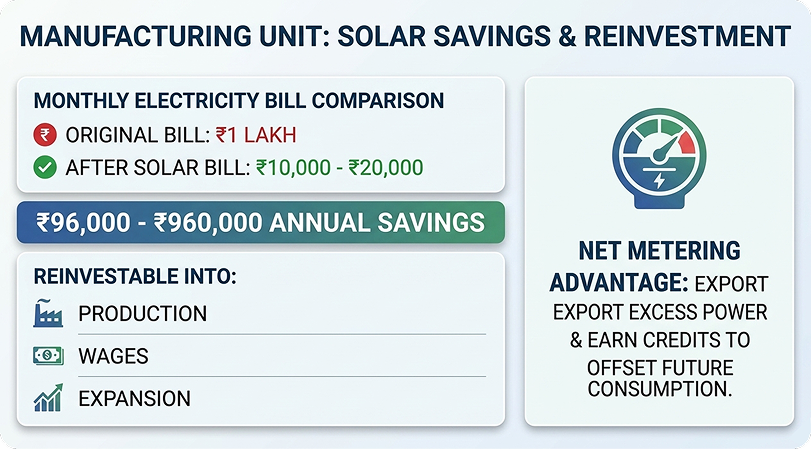
Consider this: A manufacturing unit with a ₹1 lakh monthly electricity bill could reduce it to ₹10,000-₹20,000 after installing solar. That’s ₹96,000-₹960,000 in annual savings reinvestable into production, wages, or expansion.

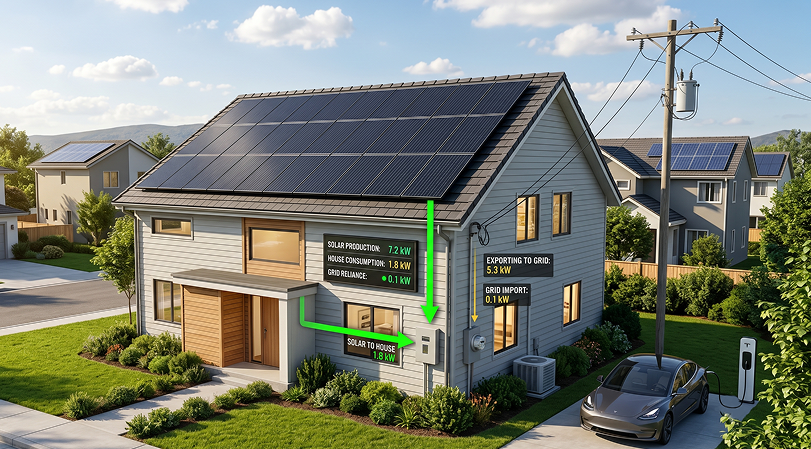
Plus, many Indian states offer net metering, allowing businesses to export excess power to the grid and earn credits that offset future consumption.

Solar Helps Businesses Achieve Predictable Energy Costs

Distributed Energy Generation: The Future Is Decentralized

India is shifting toward decentralized power generation. Instead of relying solely on massive thermal plants hundreds of kilometers away, power is increasingly generated where it’s consumed – on rooftops, factory floors, and parking canopies.

This distributed model:

At Solitech Solar, we’ve seen how Indian solar technology, built for extreme climates and performance reliability, is now powering projects from Australia’s deserts to Europe’s rooftops.

Common Misconceptions About Energy Independence

“Solar only works for large homes and factories.”

False. A system as small as 1 kW needs just 80 sq ft of roof space – perfect for modest homes.

“Solar doesn’t work during power cuts.”

Not anymore. Hybrid inverters with battery storage keep your critical loads running during outages.

“It takes forever to recover the investment.”

With falling panel prices and government subsidies, systems typically pay for themselves within 4-6 years, yet last 25+ years.

The Future of Energy Independence in India

Government support is accelerating adoption. Under the PM Surya Ghar Muft Bijli Yojana, homeowners can receive:

State-level DISCOMs offer additional rebates, and low-interest loans through nationalized banks make financing accessible.

As cooling demand grows with longer summers and per-capita consumption rises, solar will become the default choice for energy security – not just an alternative.

Frequently Asked Questions

Can solar make a home completely energy independent?

Yes, with a properly sized rooftop system and battery storage, homes can achieve near-total independence, especially in sunny regions like Gujarat.

What happens during power outages?

Hybrid solar systems with battery backup automatically switch to solar power, keeping lights, fans, and critical appliances running without interruption.

Is solar only for large homes and factories?

No. Systems start at 1 kW (requiring just 80 sq ft), making them ideal for small homes, apartments with terrace rights, and small shops.

How long does it take to recover the investment?

Most systems pay for themselves in 4-6 years through bill savings, while producing free electricity for 25+ years.

Does solar reduce dependence on rising electricity prices?

Absolutely. Once installed, solar locks in your energy cost, shielding you from annual tariff hikes that typically range 5-8%.

Conclusion

Energy independence is no longer a futuristic concept – it’s happening now across India. From Surat homes beating summer outages to factories stabilizing operational costs, solar is giving individuals and businesses greater control, predictability, and resilience in an increasingly energy-dependent world.

At Solitech Solar, we believe the best time to gain that control was years ago. The second-best time is today.

RELATED BLOG

TOPCon Technology The Next Big Thing In Solar

TOPCon Technology: The Next Big Thing In Solar

The demand for solar energy is increasing worldwide and a large number of people are becoming aware of it. So it is natural that due to this response, the latest technology comes into the solar sector. TOPCon solar panels are one of them.

Read More...
How Solitech Solar Ensures You Stay 100% Compliant with New Environmental Laws

How Solitech Solar Ensures You Stay 100% Compliant with New Environmental Laws

Everything on earth, whether it is an electronic thing or any other thing, is certain to be destroyed. But it is very important to manage the thing once used so that no problem related to the environment arises. This applies when it comes to solar panels. Friends, solar panels give us the joy of uninterrupted energy for 25 years. After such a long time, when the efficiency of the panel decreases, it is necessary to manage it. The government is also taking steps in this regard, so the government has implemented many rules so that there is no harm to the environment. In 2026, this question is not just about the environment, but about the law. The Indian government has implemented very strict E-Waste Management Rules for the disposal of solar panels.

Read More...