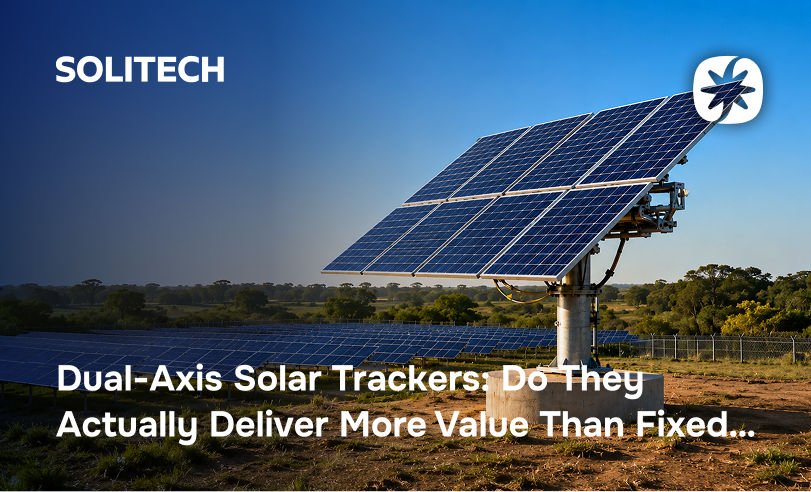
Dual-Axis Solar Trackers: Do They Actually Deliver More Value Than Fixed Panels?


Picture this: your rooftop solar system is performing reasonably well, but your electricity bills are still higher than expected. Output is strong at noon but drops sharply in the early morning and late afternoon. Your installer mentioned trackers during the initial conversation – but is that technology actually relevant for your situation, or is it complexity you do not need?

The honest answer depends almost entirely on your site, your scale, and your energy objectives.

Why Fixed Panels Leave Energy on the Table

A conventional fixed-tilt solar panel is angled once during installation and stays there permanently. It is optimized for midday generation but captures significantly less energy during sunrise and sunset hours when the sun’s angle is far from ideal. Across a full day, a fixed panel captures perhaps 65% to 75% of the sunlight it theoretically could – and that gap represents real, recoverable energy at larger scales.

What Dual-Axis Trackers Actually Do

Single-axis trackers rotate panels east to west, following the sun’s daily arc. Dual-axis trackers go further, also adjusting for the sun’s changing elevation across seasons. In December, the sun sits lower than in June – a dual-axis system compensates for both dimensions simultaneously, keeping panels as perpendicular to incoming sunlight as possible throughout the entire day and year.

The mechanism is straightforward: sensors or astronomical algorithms determine the sun’s position, motors adjust panel orientation continuously, and the system optimizes the angle of incidence in real time. In favorable conditions, this delivers energy yield improvements of 35% to 45% over fixed installations – a gain that no panel efficiency upgrade alone can match.

Where Dual-Axis Trackers Genuinely Make Sense

For applications where maximizing generation from limited land area is critical, dual-axis trackers present a compelling case. A smaller tracked array can outperform a larger fixed installation – which matters when land costs are high or grid connection capacity is constrained. Research facilities, remote telecom infrastructure, agricultural pumping systems, and industrial facilities with specific high-output requirements represent the strongest use cases. At utility scale, on flat unobstructed land, the 25-year generation advantage can justify the investment in a well-structured financial model.

The Honest Limitations

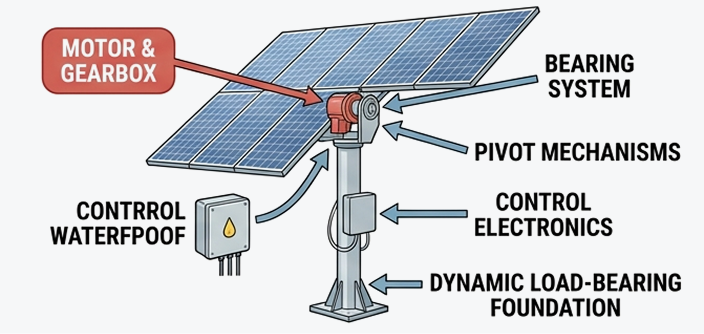
Dual-axis trackers involve motors, bearings, pivot mechanisms, control electronics, and foundations capable of supporting dynamic loads. Every additional mechanical component introduces a potential failure point. In high-dust, high-humidity, or temperature-extreme environments – familiar across much of India – mechanical systems demand regular maintenance to sustain their performance advantage.

The Honest Limitations

Installation costs are substantially higher than fixed structures. Foundation requirements are more complex, wiring must accommodate movement, and structural engineering must account for wind loading on panels that shift orientation throughout the day. For rooftop installations specifically, the additional structural weight and dynamic forces are complications most buildings are not designed to handle.

It is also worth acknowledging how much fixed panel technology has improved. A quality TOPCon panel today delivers 22% to 24% efficiency. Combine that with optimized tilt design and module-level power electronics, and a well-designed fixed system closes a significant portion of the tracking efficiency gap – at far lower cost and operational complexity.

The Indian Context

India’s conditions add specific dimensions to this analysis. Dust accumulation across northern and western India already makes cleaning of fixed installations demanding – mechanical tracking systems require additional attention. Monsoon seasons expose moving parts to moisture and debris. In dense urban environments where rooftop solar is most common, structural constraints make ground-mounted tracking largely impractical.

Where trackers find genuine relevance in India is in ground-mounted commercial or agricultural projects in less developed areas – particularly where high generation directly reduces diesel dependence or supports power sale revenue.

Conclusion

Dual-axis solar trackers genuinely deliver on their energy promise under the right conditions. The critical question is whether those conditions match your project. For most Indian residential and commercial rooftop installations, the cost, complexity, and maintenance demands are difficult to justify when high-efficiency fixed systems – properly designed and maintained – deliver strong returns with far lower operational risk.

The smartest solar system is not the most technically sophisticated one. It is the one designed precisely for your site, your budget, and your energy goals.

Frequently Asked Questions

Can dual-axis trackers be installed on residential rooftops?

Rarely practical. The structural load, mechanical complexity, and maintenance requirements make rooftop tracking financially difficult to justify at residential scale.

How much more energy do they generate vs. fixed panels?

Typically 35% to 45% more annually under favorable conditions, though actual gains depend on location, shading, and system quality.

What maintenance do dual-axis trackers need?

Regular inspection and lubrication of motors, bearings, and pivots, plus sensor cleaning and algorithm calibration. Frequency increases in dusty or humid environments.

Are they worth it for a 100 kWp commercial system?

Only if ground-mounted on unobstructed land and a detailed financial model confirms the additional generation revenue outweighs premium installation and maintenance costs over the project life.

How do they perform during Indian monsoon seasons?

Most systems default to a low-resistance position during high winds. However, moisture exposure to mechanical parts increases post-monsoon maintenance needs.

What simpler alternatives improve fixed panel output?

Module-level power optimizers, micro-inverters, and bifacial panels on reflective surfaces can recover a meaningful portion of the efficiency gap at lower cost and complexity.

RELATED BLOG

From Rooftops to Solar Farms: Diverse Applications of Solar Energy

From Rooftops to Solar Farms: Diverse Applications of Solar Energy Home > Blog > From Rooftops to Solar Farms: Diverse Applications of Solar Energy Solar energy is rapidly transforming the way we power our lives. As the global shift towards renewable energy accelerates, solar power has emerged as a versatile and sustainable solution to meet […]

Read More...