Japan's Space Solar Revolution and Solitech Solar's Ground-Based Vision

Japan's Space Solar Revolution and Solitech Solar's Ground-Based Vision

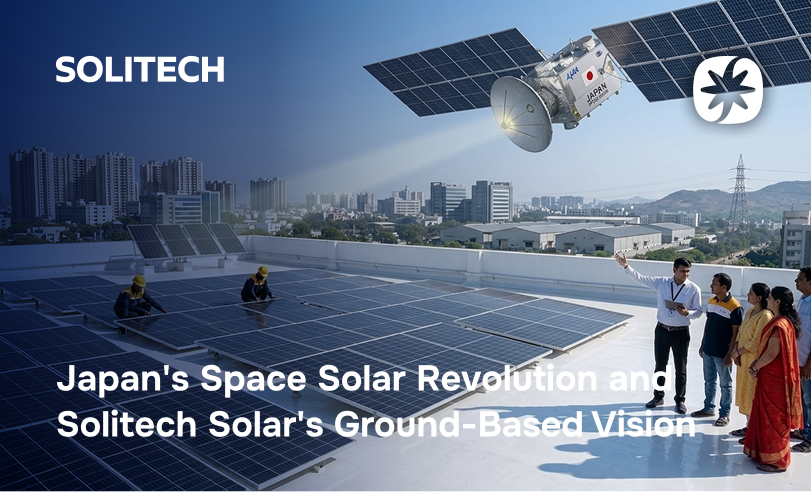
Japan’s recent announcement about space-based solar power stations has captured imaginations worldwide. The plan-beaming continuous, cloud-free solar energy from orbit via microwaves-promises baseload power without earthly limitations. While that’s years away, it validates solar’s limitless potential.

I’ve explained similar breakthroughs to over 100 Gujarat clients installing rooftop solar. They often ask: “How does space tech connect to my home system?” Solitech Solar (https://solitechsolar.com/) bridges that gap with N-Type TOPCon panels-terrestrial tech borrowing space-like durability and efficiency. Under Solar Policy 2026 India, these DCR solar panels qualify for subsidies, making advanced performance accessible now. Let’s connect Japan’s orbital ambition to practical rooftop solar Gujarat solutions.

Japan's Space Solar Power Mission Explained

Japan’s JAXA aims to launch a 1 GW orbital solar farm by 2035. Geostationary satellites with massive photovoltaic arrays capture sunlight 24/7-no nights, no clouds, 8x Earth’s intensity due to no atmospheric filtering.

Key innovation: Wireless power transmission. Microwaves convert electricity, beam to ground rectennas (rectifying antennas), and reconvert with 85% efficiency. Challenges remain-safety, scaling, costs-but prototypes succeeded in 2025 tests.

This isn’t fantasy. Satellites already power themselves entirely via solar panels, from NASA’s Artemis missions to ISRO’s GISAT. Japan’s vision scales that to grid level, reducing fossil fuel dependence.

Solitech Solar's N-Type TOPCon: Space Efficiency on Earth

While Japan builds in orbit, Solitech brings comparable tech to Gujarat roofs. N-Type TOPCon (Tunnel Oxide Passivated Contact) panels hit 22-23% efficiency—matching space-grade cells—via rear passivation that cuts recombination losses.

Advantages over standard panels:

Higher yields

10-15% more kWh in Gujarat's 5+ sun hours/day.

Low egradation

0.35%/year, retaining 90% after 30 years.

Heat resistance

Vital for 45-48°C summers; output drops just 0.3%/°C above 25°C.

ALMM-listed for DCR solar panels, they maximize Solar Subsidy 2026 (₹24,000-30,000/kW CFA). A 3 kW Solitech system generates 4,800 units/year vs. 4,200 from PERC equivalents.

Infinite Energy: From Orbit to Your Inverter

Japan solves intermittency with constant sun. Solitech mimics this terrestrially through bifacial technology-front and rear generation. Ground albedo (reflection) adds 15-25% output, especially on white rooftops common in Surat.

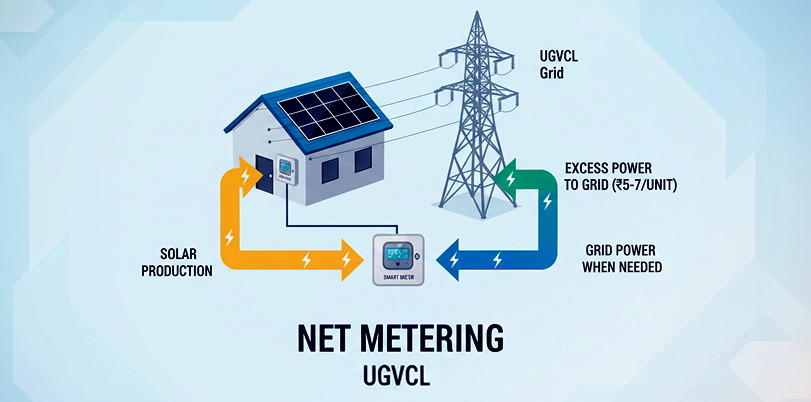
Real client example: A Vesu warehouse installed bifacial Solitech TOPCon. Cloudy monsoon days still yielded 70% capacity-closer to space’s reliability than typical panels. Paired with net metering, excess feeds UGVCL grid at ₹5-7/unit.

Future-proofing: As EVs proliferate (India targets 30% by 2030), Solitech’s smart inverters enable V2H (vehicle-to-home) charging-your car as backup battery.

Conquering Clouds and Night: Bifacial + Optimization

Space has no weather interference. Earth does. Solitech counters with:

Bifacial panels: 20-30% rear gain offsets shading/clouds.

AI tracking: Optional single-axis adds 25% annual yield.

Anti-soiling coating: Gujarat dust reduces cleaning to quarterly (₹3,000/year).

Data point: NREL studies show bifacials cut LCOE (levelized cost) by 18% in high-albedo areas. For factories, this means uninterrupted production during 2026’s projected summer loadshedding.

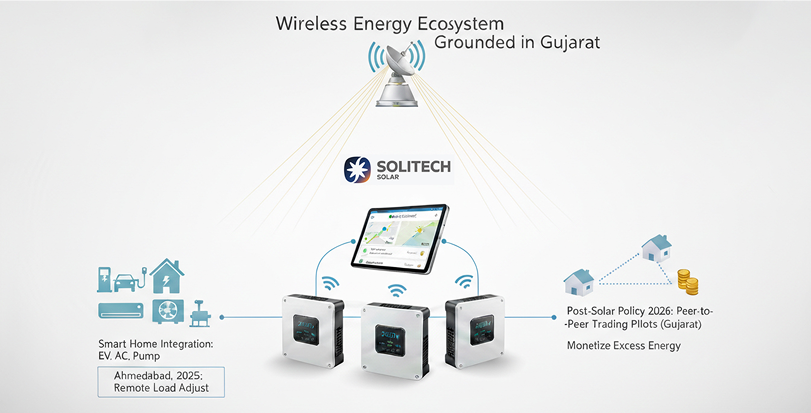
Wireless Energy Ecosystem Grounded in Gujarat

Japan’s microwave beams inspire. Solitech delivers wireless control today: Cloud-connected inverters monitor via app-real-time production, fault alerts, even OTA firmware updates. Google Maps integration optimizes tilt for your latitude.

Smart homes benefit: Integrate with EV chargers, ACs, pumps. One Ahmedabad client remotely adjusted loads during 2025 outages, prioritizing essentials.

Post-Solar Policy 2026, expect grid interactivity-peer-to-peer trading pilots in Gujarat could monetize excess at premium rates.

Cosmic Durability for Indian Conditions

Space panels endure vacuum, radiation, -150°C to 120°C swings. Solitech tests similarly: IEC 61215 standards simulate acid rain, 5400 Pa snow/wind, 85°C/85% humidity PID.

Build quality:

Aerospace aluminum frames

30-year corrosion warranty.

Dual-glass

Hail-resistant to 25mm at 23 m/s.

TOPCon passivation

Zero LID/MLPE, stable in humid monsoons.

Surat factory case: Solitech system survived 2025 Cyclone Asna winds unscathed, while neighbors’ frames bent.

Costs and ROI: Space Tech at Earth Prices

Leverage subsidies before June 2026 taper.

System Size Solitech TOPCon Cost CFA + GEDA Net Cost Annual Savings (Gujarat)
3 kW Home ₹2.3–2.6 lakh ₹75–90k ₹1.5–1.8 lakh ₹35,000–42,000
10 kW Commercial ₹7.5–9 lakh ₹2.2–2.8 lakh ₹5.3–6.2 lakh ₹1.2–1.5 lakh
50 kW Industrial ₹38–45 lakh ₹11–15 lakh ₹27–30 lakh ₹6–7.5 lakh

Payback: 4-5 years at ₹7-8/unit (rising 6%/year). 30-year value: ₹20-25 lakh home, ₹2+ crore industrial.

Steps to Space-Age Solar in Gujarat

Financing: 7-8% loans, EMIs ₹1,900/month for 3 kW.

FAQ: Japan Space Solar and Solitech Tech

What's Japan's space solar timeline?

1 GW demo by 2035; complements Solar Policy 2026 India ground solar.

Do Solitech panels match space efficiency?

N-Type TOPCon at 22-23% nears orbital cells; bifacial adds 20% Earth yield.

Cloud performance forrooftop solar Gujarat?

Bifacial + anti-soiling yields 70-80% on overcast days.

Wireless features in Solitech systems?

Cloud apps, smart inverters—V2H ready for future EVs.

Durability testing standards?

IEC 61215/61730: Heat, wind, ammonia for industrial use.

Embrace infinite energy like Japan-start with Solitech at https://solitechsolar.com/. Share questions in comments.

RELATED BLOG

How Solitech is Helping Gujarat Farmers Harvest Two Crops One from the Soil, One from the Sun

How Solitech is Helping Gujarat Farmers Harvest Two Crops: One from the Soil, One from the Sun

India has always been an agricultural country. Agriculture is a major part of India’s development, so how great it would be if solar power were connected to this agriculture! In earlier times, farmers used to grow crops in only two out of three seasons, but today, due to increasing technology, it has become possible to grow crops in all three seasons. In the modern era, Solitech Solar has brought a technology that is installed directly on the crop, not on the farmer’s roof or farm fence. Have you seen a blockbuster scene of your favorite movie hero? Just imagine if there are crops floating on the ground and solar panels just above it, the energy is doubled.

Read More...