








India's Solar Manufacturing Boom Is Changing the Way Developers Choose Their Module Suppliers

India Solar Manufacturing Boom Is Changing the Way Developers Choose Their Module Suppliers-main


A few years ago, module procurement often came down to one line on a quotation. Today the conversation is wider. As Indian manufacturing capacity grows, developers, EPC companies and distributors are asking a harder question: which manufacturer can we rely on for the next twenty-five years? Brands like Solitech Solar, one of India’s fastest-growing solar module manufacturers, are shaping how that question gets answered.

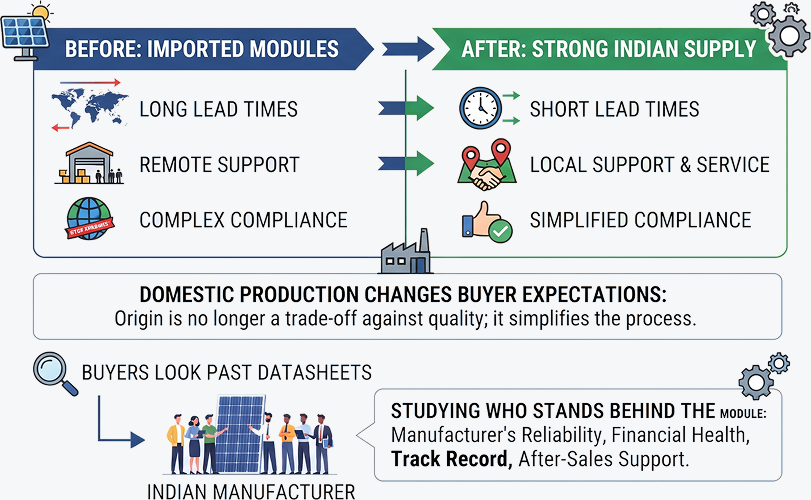
From Imported Modules to Indian Supply

Strong domestic production has changed what buyers expect. When a reliable Indian solar module manufacturer sits a few states away, lead times shrink, support gets local and compliance becomes simpler. Developers no longer have to treat origin as a trade-off against quality.

That shift has also raised the bar. With more Indian manufacturers to compare, buyers look past the datasheet and study who stands behind it.

From Imported Modules to Indian Supply

What Developers Check Now

Compliance

ALMM enlistment and BIS certification are the starting point, especially for government and institutional work. An ALMM solar panel manufacturer with BIS certified solar modules clears the first filter.

Track record

Installed projects say more than brochures. Industrial plants and government campuses show how modules behave over time.

Supply security

Supply security

Delivery timelines, distribution reach and control over the supply chain matter on any project with a fixed commissioning date.

Support

Support

Warranty assistance and technical help after installation decide whether a problem takes days or weeks to solve.

Technology

Technology

High-efficiency designs, including N-Type TOPCon, and low degradation determine energy yield over the project's life.

Gujarat's Module Hub and the Rise of Solitech Solar

Gujarat has become a serious center for module manufacturing, and Solitech Solar is one of the solar panel companies in Gujarat driving that momentum. As an Indian solar module manufacturer, Solitech Solar is ALMM enlisted and BIS certified, which makes its modules eligible for government and institutional projects.

The factory floor matters just as much. Solitech Solar produces Tier-1 quality modules with German manufacturing technology and advanced automated production, using raw materials sourced from globally recognized suppliers. Behind that sits a team with more than 17 years of combined experience in the solar industry.

Track record follows the same pattern. Solitech Solar modules have gone into an approximately 13 MW solar project at the Tata Motors manufacturing plant in Tamil Nadu and into the NDRF campus in Nagpur. In agriculture, Solitech Solar has become a preferred PM-KUSUM solar panel manufacturer, with wide participation in agricultural solar pump projects.

Supply matters too. A wide distribution network across India supports easier availability and faster deliveries, and dedicated technical support, quick warranty assistance and dealer support keep the relationship going after dispatch.

Different Segments, Different Priorities

Residential rooftops

Homeowners care about efficiency, aesthetics and long-term savings. For a rooftop solar panel manufacturer, that means modules that look good and keep performing.

Commercial and industrial

C&I buyers focus on lower electricity costs, reliable generation and return on investment. Solitech Solar modules are widely chosen for both rooftop segments.

Agriculture

Farmers need dependable solar modules for agriculture that hold up under Indian field conditions, which is where the PM-KUSUM track record counts.

Different Segments, Different Priorities

Beyond Modules: Solitech Solar's Move Into Ingots and Wafers

Forward integration is where the boom heads next. Solitech Solar plans to enter solar ingot and wafer manufacturing, aiming for tighter supply chain control, better product quality and a stronger push toward self-reliance in Indian solar manufacturing. Buyers are watching moves like this closely, because they separate assemblers from manufacturers they can trust for the long term.

Frequently Asked Questions

Why does ALMM enlistment matter when choosing a module supplier?

ALMM enlistment makes a manufacturer’s modules eligible for government and institutional projects, so it is often the first thing developers verify.

What should developers check besides price?

Compliance, installed track record, supply reliability, after-sales support and module technology all affect long-term returns more than the quoted rate alone.

Is Solitech Solar ALMM enlisted and BIS certified?

Yes. Solitech Solar modules are ALMM enlisted and BIS certified, and they are manufactured according to Indian quality standards.

Which projects have Solitech Solar modules powered?

Solitech Solar modules have been installed at the Tata Motors manufacturing plant in Tamil Nadu (approximately 13 MW) and the NDRF campus in Nagpur, along with PM-KUSUM agricultural solar pump projects.

Does Solitech Solar serve residential and commercial customers?

Yes. Solitech Solar modules are widely chosen for residential rooftops and for commercial and industrial installations.

What are Solitech Solar's expansion plans?

Solitech Solar plans to enter solar ingot and wafer manufacturing to strengthen supply chain control and product quality.

Related Blog

Why Solitech-Powered Assets Command a 15% Premium in 2026 Real Estate Appraisals

Why Solitech-Powered Assets Command a 15% Premium in 2026 Real Estate Appraisals

A few years ago, people believed that solar power was just a means to reduce electricity bills, but today, solar is an important device that increases the value of your property. Suppose you have bought 2 flats worth Rs 1 crore each. One of them is a normal house but the other house has a high-profile solar system from Solitech Solar installed. The value of both these types of properties will not remain the same in 2026 and in the coming years. Why do bank valuers give a premium of 10 to 15% on solar homes in the market? This remains an important question. That is what we want to talk about in this blog. Many people still live under the burden of electricity bills because they don’t know the real value of solar. We are confident that after reading this blog, you will know that solar is not only enough to reduce electricity bills to zero but also increases property asset value in the market.


Read More...
The June 2026 Deadline Why Non-DCR Panels Could Void Your Industrial Subsidy and Grid Approval

The June 2026 Deadline: Why Non-DCR Panels Could Void Your Industrial Subsidy and Grid Approval

2026 has arrived. If you are also thinking of installing solar in 2026, whether for business or in industry, then make a special note of June 1, 2026. Many rules are changing on industrial solar. According to the new rules of the Government of India, all the devices connected to the grid are going to be changed. Many customers get cheated when they plan to install solar because the company doesn’t deliver as promised. Many solar companies show high-quality panels and sell very low-quality and cheap panels. In one way, industrial solar needs more kilowatts. This year, if your panels are not made in India, you may lose lakhs of subsidy for your business. This is something to keep in mind. It is also possible that the DISCOM may not give permission at all. Today we will discuss this serious topic in detail:

Read More...