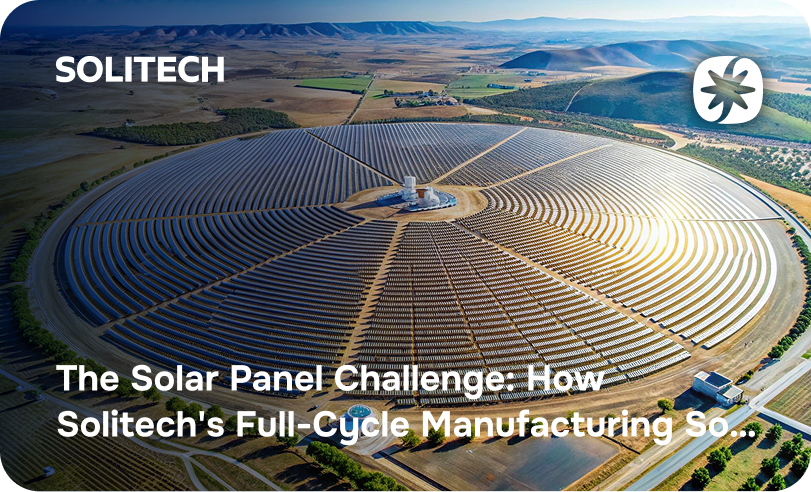
The Solar Panel Challenge: How Solitech's Full-Cycle Manufacturing Solves It?

The-Solar-Panel-Challenge-How-Solitechs-Full-Cycle-Manufacturing-Solves-It-image

The solar energy industry faces a critical challenge: ensuring consistent quality and performance across the entire supply chain. Many manufacturers rely on fragmented processes, leading to inconsistencies and potential failures. At Solitech Solar, we’ve taken a different approach a full-cycle manufacturing model that addresses these challenges head-on.

1. The Problem Inconsistencies in Solar Panel Production

Sourcing Variability

Relying on multiple suppliers for raw materials can lead to variations in quality.

Process Gaps

Disconnected manufacturing stages can introduce errors and inefficiencies.

Process Gaps

The-Problem-Inconsistencies-in-Solar-Panel-Production-image

Disconnected manufacturing stages can introduce errors and inefficiencies.

Variable Quality

This ultimately leads to variable quality in the end product.

2. Our Full-Cycle Manufacturing Excellence!

Solitech Solar’s full-cycle approach tackles these problems by integrating every stage of the manufacturing process:

Rigorous Material Selection Solution

  • We address sourcing variability by establishing strict quality standards and working with trusted suppliers.
  • This ensures that every component meets our exacting specifications.

Integrated Production Lines Solution.

Our-Full-Cycle-Manufacturing-Excellence-image
  • Our state-of-the-art facilities feature seamless production lines, minimizing process gaps and maximizing efficiency.
  • ERP and MES systems provide real time monitoring..

End-to-End Traceability Solution.

  • We maintain detailed records at every stage, allowing us to trace the origin of every component and track the progress of every panel.
  • This allows us to rapidly solve any issue.

Stringent Quality Control Solution.

  • We maintain detailed records at every stage, allowing us to trace the origin of every component and track the progress of every panel.
  • This allows us to rapidly solve any issue.

Stringent Quality Control Solution.

  • We implement rigorous testing procedures at every stage, from raw materials to finished panels.
  • This ensures that every Solitech Solar panel delivers consistent performance and reliability.

3. The Benefits of Superior Quality and Performance

Consistent Quality

Our full-cycle approach ensures that every panel meets the highest standards.

Enhanced Reliability

Rigorous testing and quality control minimize the risk of failures.

Optimized Performance

Our integrated processes maximize efficiency and performance.

Customer Confidence

Our commitment to quality and traceability builds trust and confidence.

Solitech Solar’s full-cycle manufacturing model is more than just a production strategy; it’s a commitment to delivering superior solar energy solutions. We’re dedicated to building a sustainable future, one high-quality solar panel at a time.

Contact Solitech Solar today.

RELATED BLOG

How Solitech is Cutting Cold Storage OpEx by 40% for Gujarat’s Agro-Exporters

How Solitech is Cutting Cold Storage OpEx by 40% for Gujarat’s Agro-Exporters

Many states of India are located on the coast. This is especially true of Gujarat. In Gujarat, agro hubs have developed in Kutch and Saurashtra. Import and export of goods are very important for the development of the country and increasing national income. We buy many things from other countries and export to other countries. Due to the increasing demand for agro exports, it is very important to store vegetables and fruits. About 30% to 40% of total cold storage is used for storing such items. In such a situation, you can imagine that all profit is lost. Rising tariffs and peak-hour charges are eroding exporters’ profit margins. Solitech Solar has clients like these who are looking for solar systems in agro export, which have proven to be a game-changing solution for such businesses. Taking advantage of Gujarat’s new renewable policy, the cost of cold storage systems, which was around 40%, has now been reduced through solar.

Read More...