Why Are Solar Panels Installed at an Angle? The Science Behind Maximum Power Generation


Walk past almost any solar installation in India and you’ll notice something: the panels are never lying flat. There’s a reason for that tilt, and it’s not just about looks. The angle at which a solar panel sits can change how much electricity it generates by a significant margin, which is why the module quality behind that installation matters just as much as the angle itself. This is exactly where a manufacturer like Solitech Solar, one of India’s fastest-growing solar module manufacturers, makes the real difference.

The Surprising Part Most People Miss

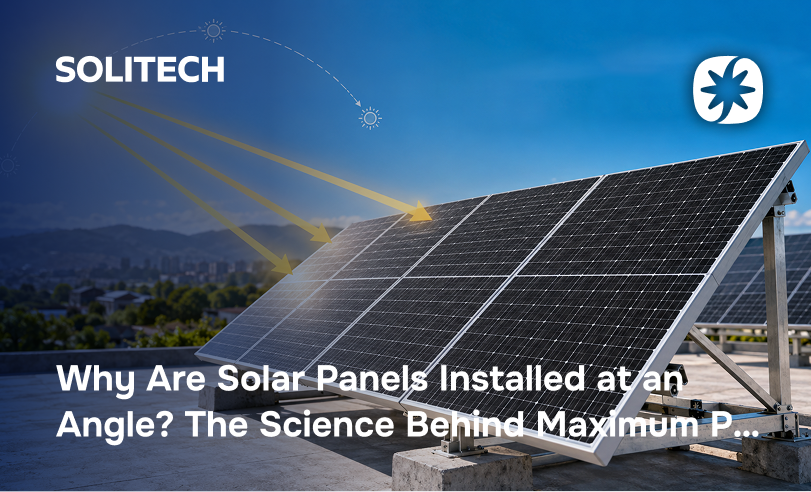
Most people assume solar panels just need “more sun” to work well. The surprising truth is that direct, perpendicular sunlight matters far more than total sun exposure. When sunlight hits a panel at an angle other than 90 degrees, a portion of that light simply reflects off the surface instead of being absorbed. Tilt the panel to face the sun more directly, and it captures noticeably more usable energy, even on a day with identical weather.

This is also why two identical panels, installed just a few degrees apart in tilt, can produce different output over a year. It isn’t the panel that changes. It’s the geometry.

The Science: Latitude and Angle of Incidence

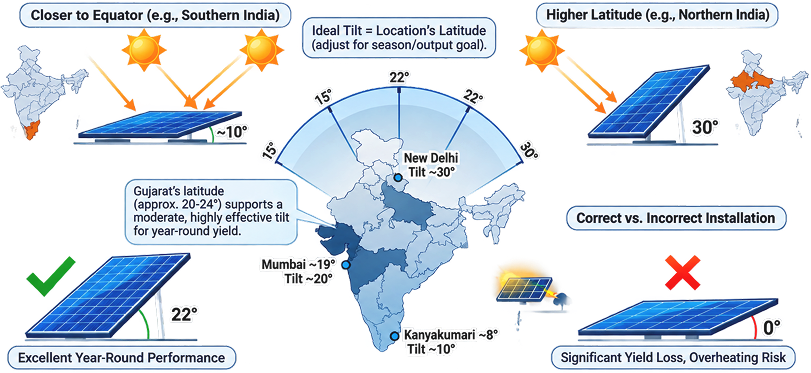
The ideal tilt for a solar panel is closely tied to a location’s latitude. The closer you are to the equator, the flatter your panels can sit. The further you move toward the poles, the steeper the tilt needs to be to face the sun directly.

For most locations across India, this generally means a tilt angle somewhere between 15 and 30 degrees, adjusted based on the city and whether the priority is maximizing annual output or squeezing out extra winter performance. Gujarat sits at a latitude where a moderate tilt captures strong output across most months of the year.

This is exactly the kind of technical detail that separates a good solar installation from an average one. Even the best High Efficiency N-Type TOPCon Solar Panels will underperform if installed flat or at the wrong angle for the region, which is why the installer’s angle decision and the manufacturer’s module quality need to work hand in hand.

The Science Latitude and Angle of Incidence

Why Solitech Solar's Module Quality Makes Angle Optimization Worth It

Getting the angle right only matters if the panel underneath can convert that optimized sunlight into real energy efficiently. This is where Solitech Solar’s manufacturing standards come in. As a Tier 1 Solar Module Manufacturer, Solitech builds its modules using advanced automated production processes and German manufacturing technology, engineered specifically for Indian climatic conditions, not just lab settings.

Solitech modules are also ALMM Enlisted and BIS Certified, meeting the standards required for government, institutional, and PM-KUSUM Yojana projects, including extensive supply for DREB KUSUM agricultural pump installations, where correct tilt angle set by the installer is especially critical for consistent water pumping performance. Every module uses raw materials sourced from globally recognized suppliers, supporting lower degradation and reliable output over the module’s working life, so the gains from correct angling hold up over 20-plus years, not just the first season.

Rooftop vs Ground-Mounted: Why Angle Strategy Differs

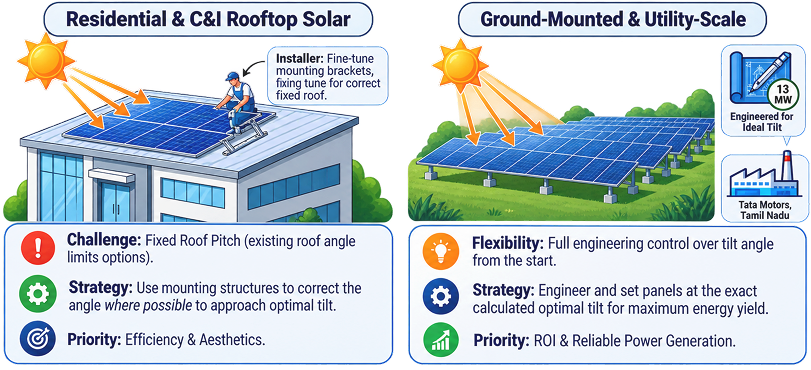
Solitech Solar modules are widely chosen by installers and EPC partners for both residential rooftop solar, where efficiency and aesthetics matter, and Commercial and Industrial (C&I) installations, where ROI and reliable power generation are the priority. The angle strategy for each differs.

Rooftop installations often work with a fixed roof pitch, so installers use mounting structures to correct the angle where possible. Ground-mounted and utility-scale projects have far more flexibility to engineer the ideal tilt from the start, which is one reason large industrial projects achieve such strong, consistent output. Solitech has supplied modules for exactly this kind of large-scale project, including an approximately 13 MW installation at the Tata Motors manufacturing plant in Tamil Nadu.

Rooftop vs Ground-Mounted Why Angle Strategy Differs

Conclusion

The tilt of a solar panel isn’t a design choice, it’s physics working in your favor when done correctly, and it’s one of those small details that quietly makes a big difference to lifetime energy output. Getting that angle right is a job for your installer or EPC partner, but the module behind it matters just as much, and that’s where Tier 1, ALMM Enlisted, BIS Certified panels from Solitech Solar earn their reputation. Whether it’s a residential rooftop, a PM-KUSUM agricultural pump, or a large C&I project, Solitech’s nationwide distribution network and dedicated technical support are there to back your installer every step of the way. Reach out to Solitech Solar to source the right module for your next project.

Frequently Asked Questions

Does the angle of a solar panel really affect Solitech Solar's module output?

Yes, correct tilt angle set during installation allows any solar module, including Solitech’s High Efficiency N-Type TOPCon panels, to capture more direct sunlight and generate higher output.

What tilt angle works best for Solitech Solar panels installed in Gujarat?

Gujarat’s latitude generally supports a moderate tilt angle in the 15 to 30 degree range, though the exact figure is decided by the installer based on the site and project goals.

Does panel angle matter for PM-KUSUM agricultural projects?

Yes, correct angling is especially important for DREB KUSUM and other PM-KUSUM agricultural pump installations, where Solitech Solar has significant module supply experience.

Are Solitech Solar modules built to perform well once correctly angled?

Yes, Solitech modules are ALMM Enlisted, BIS Certified, and manufactured using German technology and premium raw materials for reliable long-term performance.

Does angle strategy differ for rooftop versus large industrial projects?

Yes, rooftop installations adjust for existing roof pitch using mounting structures, while ground-mounted projects, like the approximately 13 MW Tata Motors installation Solitech supplied modules for, can be engineered for ideal tilt from the start.

Is Solitech Solar a good module choice for both residential and C&I installations?

Yes, Solitech modules are widely chosen by installers for residential rooftops for their efficiency and aesthetics, and for Commercial and Industrial projects for lower costs and strong ROI.

Does Solitech Solar support the installers and dealers who set up its modules?

Yes, as a manufacturer, Solitech provides dedicated technical support and works through a wide nationwide distribution network to back its installer and dealer partners with local guidance.

Related Blog