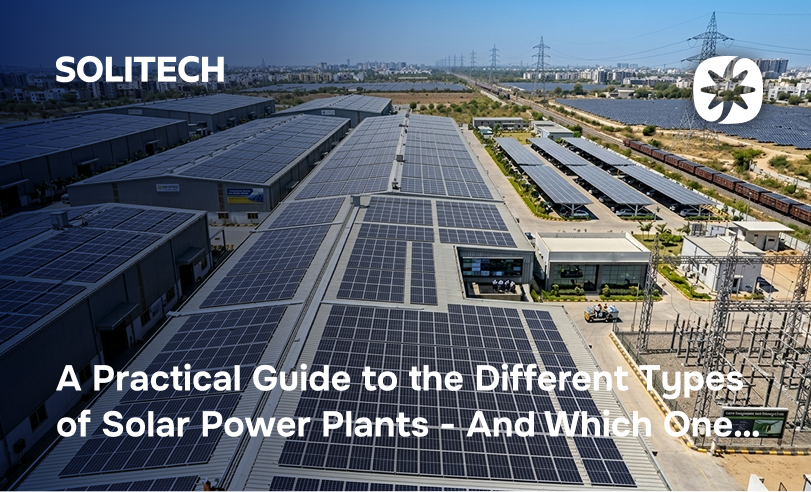
A Practical Guide to the Different Types of Solar Power Plants - And Which One Is Right for You

A Practical Guide to the Different Types of Solar Power Plants - And Which One Is Right for You-1
 

Picture this. It’s May in Ahmedabad. The temperature is touching 43°C, the AC is running full blast, and your electricity bill is headed somewhere painful. Your neighbour’s bill dropped from ₹18,000 to under ₹4,000 after going solar. You’re interested – but the moment you start researching, you hit a wall of terminology. On-grid. Off-grid. Hybrid. Utility-scale. Rooftop. What does any of it mean?

That’s exactly what this guide is for.

What Is a Solar Power Plant?

A solar power plant is any system that converts sunlight into usable electricity using solar panels. What varies across different types is the size, configuration, and purpose – and understanding those differences is what helps you make the right decision.

The Different Types of Solar Power Plants

On-Grid Solar Power Plant

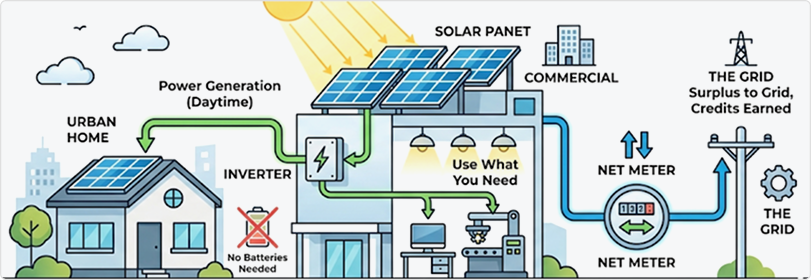
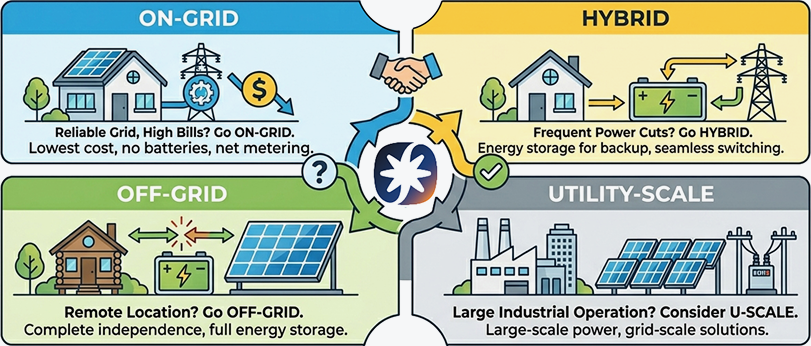
The most popular choice for urban homes and businesses. Your panels generate power during the day, you use what you need, and surplus goes back to the grid – earning you credits through net metering. No batteries needed, which keeps costs lower. The one limitation: if the grid goes down, your system shuts off too.

Best for: Urban homes, offices, and factories with reliable grid connectivity.

On-Grid Solar Power Plant

Off-Grid Solar Power Plant

No grid connection at all. Your panels charge batteries during the day, and you draw from them when the sun isn’t shining. Essential for remote villages, agricultural land, or anywhere grid access is poor or non-existent.

Best for: Rural homes, farms, and areas with unreliable or absent grid supply.

Hybrid Solar Power Plant

The best of both worlds. Connected to the grid and equipped with battery storage. Solar powers your daytime consumption, excess charges the batteries, and during a power cut, the batteries take over seamlessly.

Best for: Homes and businesses with frequent power cuts and high electricity bills.

Utility-Scale Solar Power Plant

Massive installations spread across open land, generating megawatts for entire districts. Built by energy companies or government bodies, feeding power directly into the national or state grid. Large industrial groups also use these for captive power under open access policies.

Best for: Power developers, large industrial groups, and government projects.

Rooftop Solar Power Plant

Your existing roof becomes your power plant. No extra land, no complicated approvals. Lower bills and net metering credits start from day one. For factories, warehouses, and housing societies, rooftop solar is often the fastest-payback solar investment available.

Best for: Homes, offices, schools, hospitals, and factories with adequate rooftop space.

Which Type Is Right for You?

Reliable grid and high bills? Go on-grid. Frequent power cuts? Go hybrid. Remote location? Go off-grid. Large industrial operation? Consider utility-scale.

The wrong system doesn’t just underperform – it costs you. Matching the system to your actual situation – your consumption, location, and grid reliability – is what determines whether solar truly delivers.

This is where expert guidance matters. Solitech Solar’s approach starts with understanding your specific energy needs first, then recommending the right configuration – not a generic solution, but one that actually fits.

which-type-is-right-for-you

Conclusion

Solar isn’t one thing. It’s a family of solutions, each built for a different context. Whether you’re a homeowner in Pune, a factory owner in Surat, a farmer in Rajasthan, or running a commercial complex in Bengaluru – there’s a solar power plant designed for your situation.

The sun is generous. The technology is ready. The only question is: which system is right for you?

Frequently Asked Questions

What is the difference between on-grid and off-grid solar?

On-grid connects to the electricity grid and reduces bills through net metering but won’t work during power cuts. Off-grid runs on battery storage independently – ideal for areas with unreliable or no grid supply.

Which solar system is best for a home in India?

On-grid rooftop solar suits most urban homes. If power cuts are frequent, go hybrid. Off-grid only makes sense when grid access is genuinely limited.

Can a factory use rooftop solar?

Absolutely. Factories consume heavily during daytime hours – exactly when solar generates the most – making payback periods faster and savings larger than most residential setups.

How much rooftop space do I need?

Roughly 10 square metres per kW of capacity. A 10 kW system needs about 100 square metres of shadow-free roof space.

Do I need batteries?

Not always. If your grid is stable, on-grid without batteries works well. Add batteries only if you need backup power or want greater grid independence.

What is net metering?

It lets you send surplus solar power back to the grid for bill credits. You pay only the net difference between what you consumed and what you exported.

How long does a solar system last?

Panels last 25-30 years. Inverters typically last 10-15 years. Batteries last 5-10 years. With proper maintenance, the system delivers returns for decades.

How do I choose the right type?

Assess your monthly consumption, grid reliability, and budget. Then work with an experienced solar company that understands your energy profile and recommends accordingly – not just what’s easiest to sell.

RELATED BLOG

The Solar Weight Test Why Frame Thickness is the Secret to Surviving 200 km per h Storms

The Solar Weight Test: Why Frame Thickness is the Secret to Surviving 200 km/h Storms

Let me say at the outset, Solitech Solar is another name for sustainability and quality.
When we buy a solar panel, the first thing we pay attention to is the price and wattage. But have you ever thought about its frame? Especially in Gujarat, there are many areas where wind speed is very high. In such a situation, if the panels do not work, the investment goes to waste. 25-year warranty means nothing.

Read More...
Top 10 Solar Manufacturing Companies in India in 2026

Top 10 Solar Manufacturing Companies in India in 2026

India is racing toward its ambitious renewable energy goals, and solar manufacturing is right at the heart of that journey. With the government pushing for domestic production and global demand for clean energy soaring, Indian solar manufacturers have stepped up in a big way.

Read More...