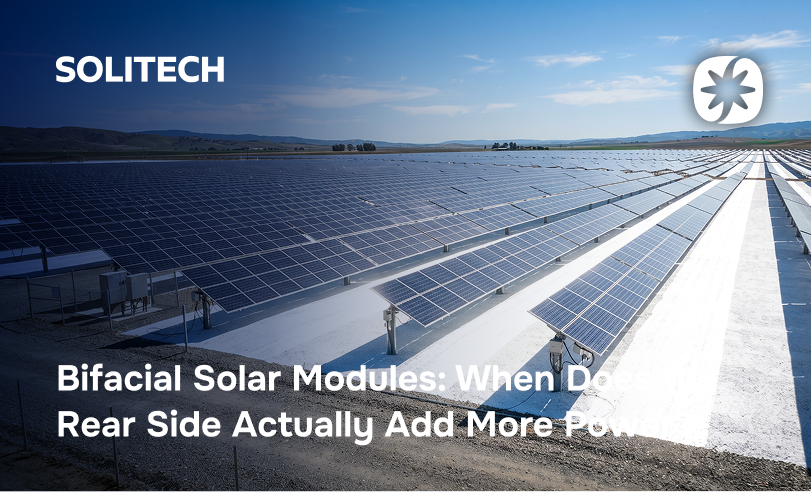

Bifacial Solar Modules: When Does the Rear Side Actually Add More Power?

A bifacial module generates power from both faces, which sounds like a free upgrade. In practice the extra energy depends on the site, not just the panel. Here is when the rear side really earns its keep, and how Solitech Solar’s bifacial modules fit in.

What the Rear Side Actually Collects

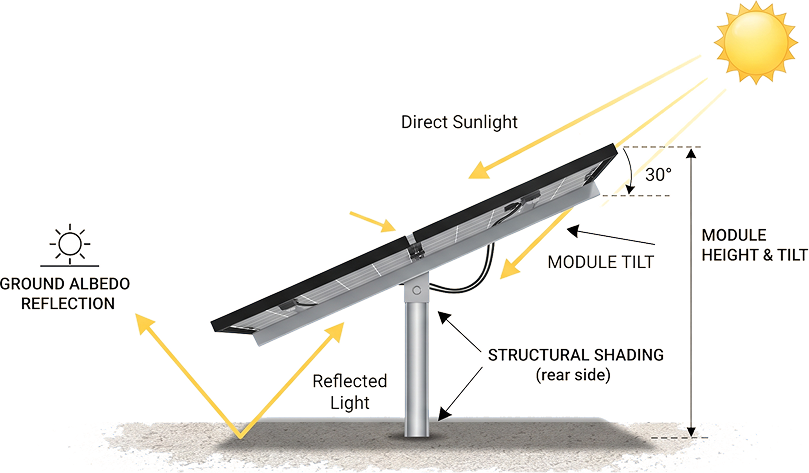
The back of a bifacial module does not face the sun. It collects light that bounces off the ground or roof beneath and scatters in from the sky. So the rear gain is set by how much light reaches the back, which comes down to three things: how reflective the surface below is, how high and how tilted the modules are, and how much the structure shades the rear.

Ground Reflectivity Matters

Surface reflectivity, called albedo, is one of the key factors. Dark soil, grass and weathered concrete reflect relatively little. Light-coloured gravel, white membrane roofing and reflective coatings reflect far more. As a rough guide, the same module can add several percent over a dark surface and noticeably more over a bright one. White-coated flat roofs are one practical way to raise it on a rooftop. Ground conditions, such as soil colour, vegetation and surface cleanliness, influence reflectivity, while dust on the rear glass can reduce the light reaching the cells.

Height, Tilt and Spacing

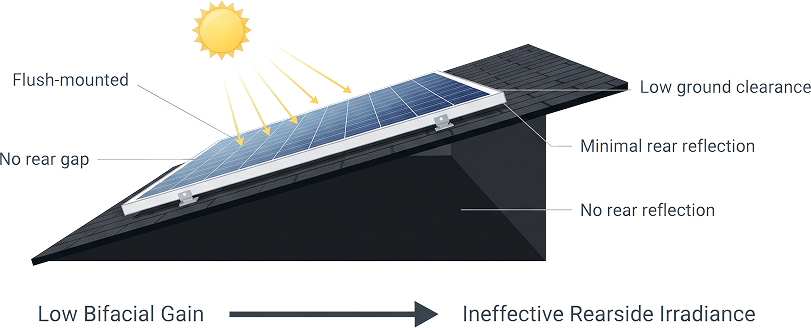
The higher a module sits above the surface, the more reflected light reaches its back, and the less it is blocked by the module’s own shadow on the ground. Tilt and row spacing matter for the same reason: tightly packed rows leave little bright ground between them. Rails and cross-beams can also shade the rear cells. This is why a bifacial module flush on a roof gains little, while one raised on a ground-mount or open elevated structure can gain much more.

Where the Rear Side Adds Little

Flush-mounted panels on a dark sloped roof leave almost no gap or reflection for the rear face to use. Low ground clearance, dense row spacing and shaded or dark surfaces cut the gain further. In these cases a bifacial module still works as a normal module, but you should not count on a big energy bonus, and the extra cost may not pay back.

Estimate Before You Commit

Ask your installer or EPC partner to model the energy yield with your actual roof or land surface, module height, row spacing and local weather. Compare the result against a monofacial module of similar rating, and weigh the extra energy against any price difference. A good simulation turns the rear-side gain from a marketing claim into a number you can plan around.

Where Solitech Solar Fits In

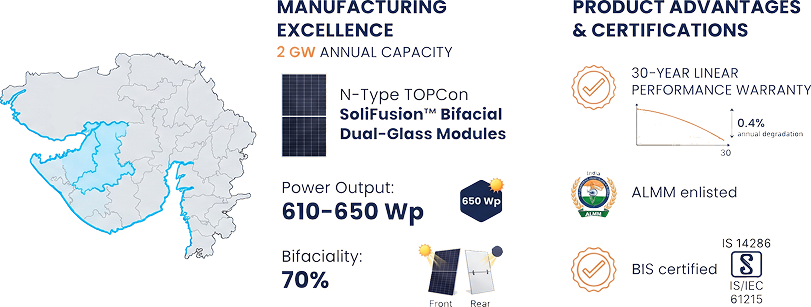
Solitech Solar, a Gujarat-based module manufacturer with 2 GW of production capacity, builds N-Type TOPCon modules, and its SoliFusion range (610 to 650 Wp) is a bifacial dual-glass module. The SoliFusion datasheet lists a bifaciality factor of 70 ± 5%. The datasheet’s backside power gain table shows illustrative scenarios for a 650 Wp module: 681 W, 711 W, 742 W and 772 W at rear-gain levels from 5% to 20%. These are not guaranteed real-world output, since actual gain depends on mounting structure and ground reflectivity. The modules are ALMM enlisted and BIS certified, with a 30-year linear performance warranty and a 12-year product warranty. Solitech makes modules, so mounting height, spacing and layout stay with your installer or EPC partner.

Conclusion

The rear side adds the most when the surface below is bright, the modules sit high with open row spacing and little structure shades the back. It adds little when modules are flush on a dark roof. Check the site first, then the datasheet. To compare bifacial options for your project, speak with the Solitech Solar team.

Frequently Asked Questions

What should buyers look for in a bifacial module manufacturer?

Published bifaciality factor, rear-gain scenarios, degradation and warranty terms, plus ALMM and BIS status. Solitech Solar publishes these details for the SoliFusion.

Does Solitech Solar make bifacial modules?

Yes. The SoliFusion (610 to 650 Wp) is a bifacial dual-glass N-Type TOPCon module.

What is the SoliFusion’s bifaciality factor?

The datasheet lists 70 ± 5%, with actual rear gain depending on mounting structure and ground reflectivity.

What warranty does the SoliFusion carry?

A 30-year linear performance warranty and a 12-year product warranty. Check the warranty document for terms.

Are Solitech modules ALMM listed?

Yes. They are ALMM enlisted and BIS certified, but eligibility for a project depends on the applicable scheme and its requirements.

Does Solitech Solar install solar systems?

No. Solitech manufactures modules. Installation is handled by installers and EPC partners.

Related Blog