
The Future of Solar Panels: 8 Breakthrough Technologies Shaping Solar by 2030

The Future of Solar Panels 8 Breakthrough Technologies Shaping Solar by 2030-main


The solar industry is changing faster than most buyers realize. New cell technologies, smarter manufacturing, and better quality standards are reshaping what a “good” solar panel even means. For homeowners, EPC companies, and distributors alike, understanding where the industry is headed – and choosing a manufacturer already building for it – is becoming just as important as comparing price per watt.

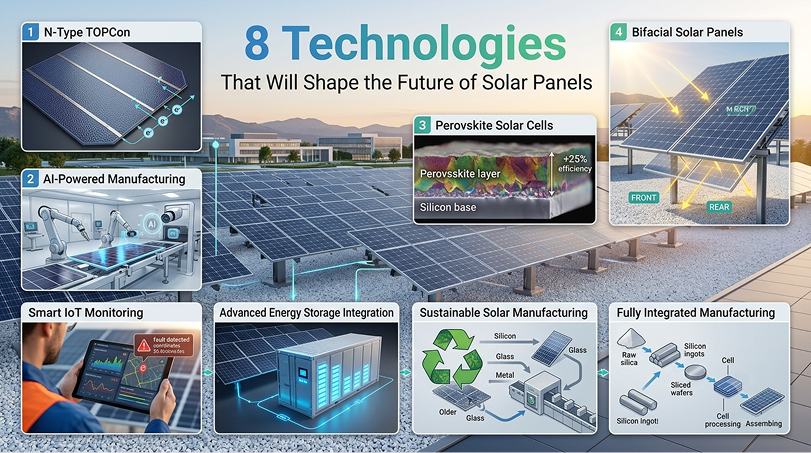
8 Technologies That Will Shape the Future of Solar Panels

N-Type TOPCon

cells outperform older P-type technology with higher efficiency and slower degradation.

The benefit: more power generated per panel, year after year. It’s fast becoming the baseline for new installations, not a premium upgrade.

AI-Powered Manufacturing

uses machine vision and automated inspection to catch defects human checks miss.

The benefit: more consistent module quality across every batch, since inconsistent manufacturing is one of the biggest hidden causes of underperforming systems.

Perovskite Solar Cells

use a different crystal structure that can push efficiency beyond traditional silicon in lab conditions.

The benefit: potentially higher output per panel, likely first arriving in tandem perovskite-silicon cells once durability challenges are resolved.

Bifacial Solar Panels

generate power from both sides, capturing reflected light off rooftops or ground surfaces.

The benefit: extra output without extra rooftop space, especially valuable for ground-mounted and utility-scale projects.

Smart IoT Monitoring

tracks panel-level performance in real time, flagging issues before they show up as output drops.

The benefit: predictive maintenance instead of reactive fixes, catching faults before they get expensive.

Advanced Energy Storage Integration

pairs solar systems with better battery technology for genuine grid independence.

The benefit: stored solar power available during outages or peak-tariff hours, turning solar into round-the-clock power.

Sustainable Solar Manufacturing

focuses on cleaner raw material sourcing and recovering materials from decommissioned panels.

The benefit: lower environmental impact across a panel’s full life cycle, as the first wave of installed panels nears end-of-life.

Fully Integrated Manufacturing

controlling everything from ingots to wafers to cells to finished modules – improves consistency and supply chain reliability.

The benefit: fewer quality variations between batches than assembly-only manufacturers can offer.

8 Technologies That Will Shape the Future of Solar Panels

How Solitech Solar Is Already Building the Future of Solar

Understanding these trends is one thing. Choosing a manufacturer already positioned around them is another. Solitech Solar’s approach reflects many of these shifts in practice, not just in marketing language.

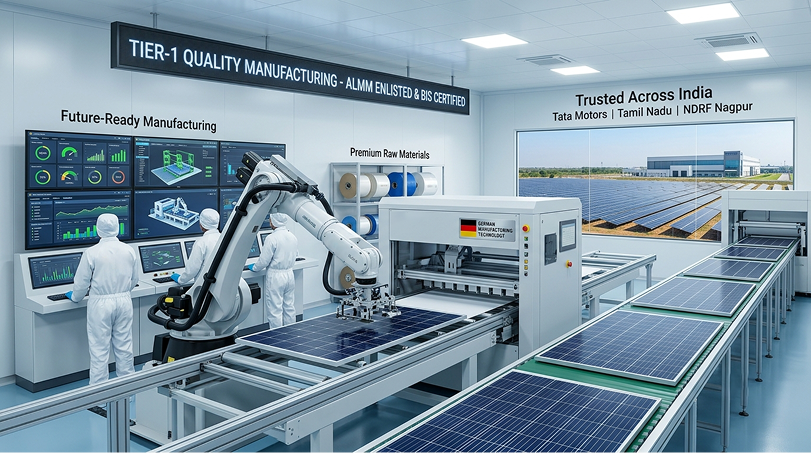
Future-Ready Manufacturing.

Solitech Solar runs advanced automated production processes that catch inconsistencies early and keep output uniform across large runs, with continuous investment in updated lines rather than treating equipment as a one-time purchase.

Tier-1 Quality Manufacturing.

Tier-1 status reflects a verified track record of bankable, financially stable manufacturing with consistent output quality – translating for buyers into higher efficiency and a panel less likely to underperform its rated output a decade in.

German Manufacturing Technology.

Precision engineering rooted in German manufacturing standards means tighter tolerances during lamination and cell placement, which shows up later as lower degradation and better resilience in Indian heat, dust, and monsoon conditions.

Premium Raw Materials.

The glass, backsheet, encapsulant, and cell-grade silicon in a module determine most of its long-term behavior. Premium materials resist UV degradation and moisture far better than budget alternatives, extending real product life rather than just spec-sheet numbers.

ALMM Enlisted & BIS Certified.

These aren’t optional paperwork – they’re what qualifies a module for most government-linked projects, including PM-KUSUM installations, and give buyers independent confirmation that a panel meets India’s safety and performance benchmarks.

Trusted Across India.

Solitech Solar’s modules serve residential, C&I, utility-scale, PM-KUSUM agricultural, and government infrastructure projects. Reported project references include the Tata Motors manufacturing plant in Tamil Nadu and the NDRF campus in Nagpur – signaling a manufacturer built for varied, demanding conditions.

Strong Distribution & After-Sales Support.

A nationwide dealer network determines how fast replacement parts, technical support, or warranty claims actually get resolved, reducing downtime for EPC partners and giving homeowners confidence support won’t disappear post-installation.

Future Expansion.

Solitech Solar has outlined plans to expand into solar ingot and wafer manufacturing, strengthening quality control at the earliest production stages and supporting India’s push toward self-reliance in solar manufacturing.

building-future-of-solar

Why Choosing a Future-Ready Manufacturer Matters

The future of solar isn’t only about which new technology gets adopted first. It’s about choosing a manufacturer that keeps investing – in innovation, precision, certification, and the support systems that matter long after installation day.

Conclusion

By 2030, the panels going up on Indian rooftops and industrial sites will look and perform very differently from what’s standard today – higher efficiency, smarter monitoring, and manufacturing built for consistency rather than volume alone. A panel is a 25-year commitment, and it’s worth backing that commitment with a manufacturer already building for the next decade, not just the next sale. Solitech Solar’s current direction, from TOPCon adoption to planned ingot and wafer expansion, is one example of what that forward-looking approach looks like in practice. Explore Solitech Solar’s current module range to see how these standards translate into real installations today.

Frequently Asked Questions

Does Solitech Solar use N-Type TOPCon technology?

Yes. Solitech Solar’s current module lineup is built on N-Type TOPCon cells, manufactured at its 2 GW capacity facility in Gujarat.

Are Solitech Solar's panels ALMM-listed and BIS-certified?

Yes, across its product range – both certifications are required for most government-linked and subsidy-connected solar projects in India, including PM-KUSUM installations.

What kind of projects has Solitech Solar supplied?

Its modules serve residential, commercial, industrial, utility-scale, and agricultural (PM-KUSUM) installations, with reported project references including the Tata Motors plant in Tamil Nadu and the NDRF campus in Nagpur.

Is Solitech Solar planning to expand its manufacturing capabilities?

Yes. The company has outlined plans to move into solar ingot and wafer manufacturing, extending its control further up the supply chain.

Does Solitech Solar offer after-sales and technical support?

Yes, through a nationwide dealer network aimed at faster local deliveries, warranty support, and responsive technical assistance for both homeowners and EPC partners.

What makes Solitech Solar's manufacturing process different?

A combination of Tier-1 quality standards, precision engineering practices, premium raw materials, and automated production processes designed to keep module quality consistent across large production runs.

Related Blog

Harnessing the Sun: The Future of Renewable Energy

Harnessing the Sun: The Future of Renewable Energy Home > Blog > Harnessing the Sun: The Future of Renewable Energy The global energy landscape is undergoing a transformative shift towards sustainability, with solar energy taking center stage. As one of the most abundant and renewable sources of energy, the sun holds the key to a […]

Read More...