Why a Solar Module Never Matches Its Cell: Tracing Efficiency Loss From Lamination to the Field

A solar cell is rated on its own, under controlled laboratory conditions. The module that reaches your site adds glass, polymer layers, metal ribbons and a frame around that cell, and each one changes the final output. In well-built modules, this cell-to-module (CTM) gap typically takes away around 2-4% of the cell’s efficiency. It sounds small, but across a large project it adds up to real energy.

What the CTM Ratio Tells You

CTM compares the power of a finished module with the combined power of the cells inside it. A ratio close to 100% means the design preserved most of what the cell could do. Because cells are only one part of the package, two modules built from the same cell can carry different ratings.

Losses on the Front Side

Glass reflection and absorption

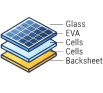
Light must cross the front glass before reaching silicon. Some bounces off and some is absorbed. Low-iron glass with a good anti-reflective coating keeps more of it moving forward.

Encapsulant behaviour

The polymer layer bonding glass to cell must stay clear and well matched optically. Poor transparency or yellowing reduces the light reaching the cell.

Ribbon shading

Interconnects sit across the cell surface and cast small shadows. Thinner ribbons and multi-busbar layouts spread current collection and block less area.

Losses From Geometry

Inactive gaps

Spaces between cells and the border around the array produce nothing, yet they occupy module area. Tighter spacing puts more active silicon under the same frame.

Area-based efficiency

Module efficiency is calculated over the whole panel, so wasted area dilutes a strong cell.

Losses on the Electrical Side

Resistive loss

Current moving through ribbons, solder joints and busbars is lost as heat. Half-cut cells carry less current per path, and since resistive loss rises with the square of current, the saving is significant.

Cell mismatch

Cells in a string are never identical. The weakest one limits the rest, so careful sorting before lamination keeps strings balanced.

Handling damage

Micro-cracks from soldering, stringing or lamination can cut output immediately or develop later. Process control on the line matters as much as the material list.

How Developers Can Judge Module Quality Before Choosing Solitech Solar

CTM compares the power of a finished module with the combined power of the cells inside it. A ratio close to 100% means the design preserved most of what the cell could do. Because cells are only one part of the package, two modules built from the same cell can carry different ratings.

Compare module efficiency

The finished module's datasheet rating is what your plant will actually see.

Ask about the build

Glass type, encapsulant, interconnection method and cell format all shape the result.

Check compliance

Confirm ALMM listing, BIS certification and test reports for the exact model.

Look at degradation terms

Strong CTM with weak long-term stability loses its advantage over the years.

Manufacturers like Solitech Solar treat this as a design and process question, since choices made at lamination and interconnection decide how much cell performance reaches the field.

Frequently Asked Questions

How much efficiency is lost between cell and module?

Well-designed modules typically lose around 2-4% of cell efficiency, depending on cell type, layout and materials.

Does higher cell efficiency always mean a better module?

No. Glass, interconnection, spacing and mismatch all affect the finished rating, so the module datasheet is the better guide.

Why do half-cut cells help?

They carry less current per path, which cuts resistive heating in ribbons and joints.

Is CTM loss the same as losses in a running plant?

No. CTM is a factory-stage figure. Temperature, soiling, wiring and inverter conversion are separate losses that come later.

What should I ask Solitech Solar or any supplier before ordering?

Request the datasheet, test reports, certification details and warranty terms for the exact model.

Related Blog

Why a 600W Competitor Might Actually Produce Less Power Than a 550W Solitech Module

Why a 600W Competitor Might Actually Produce Less Power Than a 550W Solitech Module

Suppose you go to learn music and you have a guitar. A student coming to the music class also has a guitar. His guitar is a little bigger in size and your guitar is smaller in size. The big guitar he has has various stickers stuck on it and is decorated, and the guitar you have is small. But the big guitar he has doesn’t play well and stops occasionally, whereas the guitar you have, even though it’s small, plays well. Now the question here is which guitar would you choose? We know your answer would be to choose the smaller guitar. Friends, this is not just an ordinary little story, but it teaches us a lot. The same is seen in the solar market today. Many solar manufacturers sell panels by showing big numbers, but in the long run, they cannot work for a long time and stop working halfway through. Today, many consumers who want to buy panels fall prey to such greedy figures. Solitech Solar wants to warn you well to prevent this from happening. As a leading solar manufacturer, our only goal is to provide every customer with quality panels at a low price. Let us discuss this matter in more detail in this blog.

Read More...