
India's Latest Power Shortage Raises a Bigger Question: What Happens to Solar Power After Sunset?


September was a rough month for India’s grid. As reported by Business Standard, the electricity shortfall reached 560 million units, the highest since August 2023. Hydropower output fell 20% on weaker rainfall, nearly 41 GW of generation capacity sat offline, and several coal plants ran on critically low fuel stocks. Rajasthan and Gujarat are among the states asking the Centre for extra power to avoid outages.

Strange, when you remember how much solar the country has added. But the shortage points to something more specific than too little power.

The Evening Gap

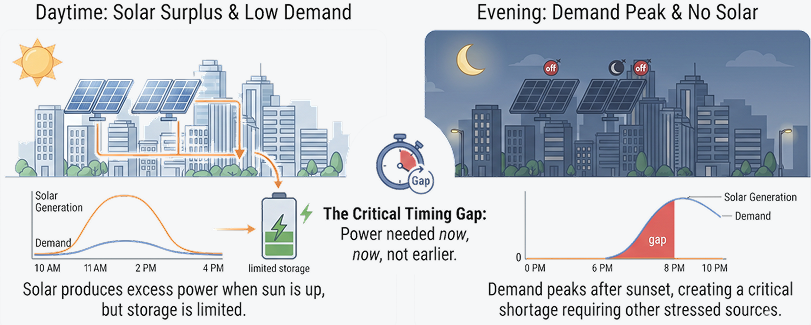
Solar generates when the sun is up, and demand peaks after it sets. With limited battery storage, surplus daytime power cannot easily be shifted to the evening, so other sources must meet peak demand. When hydro, coal and other plants are stressed at the same time, the gap shows up as shortages. It is a timing problem as much as a capacity problem.

Why Every Daytime Unit Now Counts

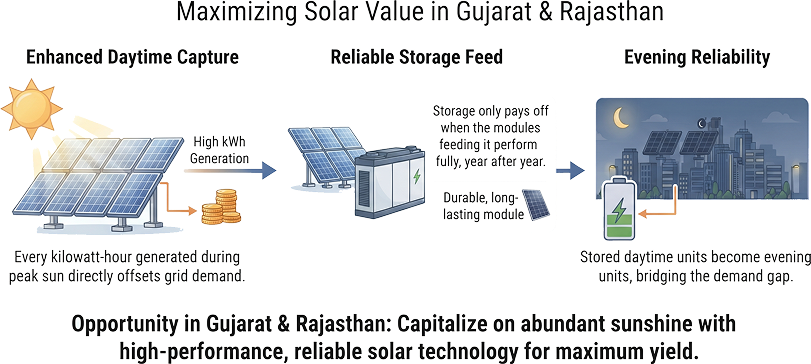
A shortage like this does not make solar less useful. It makes each daytime unit more valuable. Every kilowatt-hour a plant delivers is one the grid does not have to find elsewhere, and every unit stored becomes an evening unit. Storage only pays off when the modules feeding it perform fully, year after year. For states like Gujarat and Rajasthan, where sunshine is plentiful, the opportunity is obvious: capture more of it, and capture it reliably.

Why Every Daytime Unit Now Counts

Where Solitech Solar Fits In

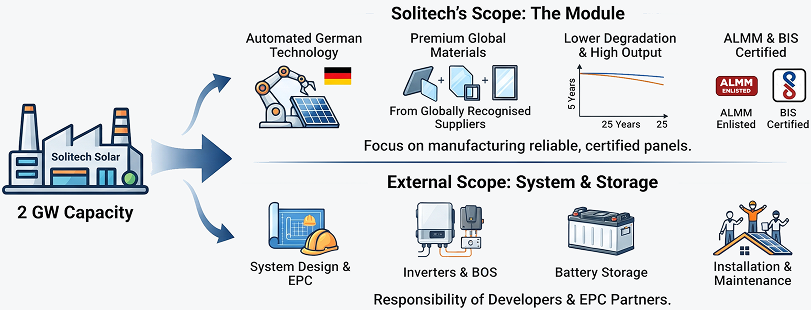
Solitech Solar is a Gujarat-based module manufacturer with 2 GW of production capacity, so this story is close to home. Its modules are built on automated lines using German manufacturing technology, with raw materials from globally recognised suppliers, aimed at lower degradation and dependable output in Indian conditions. They are ALMM enlisted and BIS certified, keeping them eligible for government and institutional projects. Solitech makes modules, not batteries or installations, so storage and system design sit with developers and EPC partners. What Solitech controls is the part underneath it all: panels that keep delivering.

Proven Where Power Matters

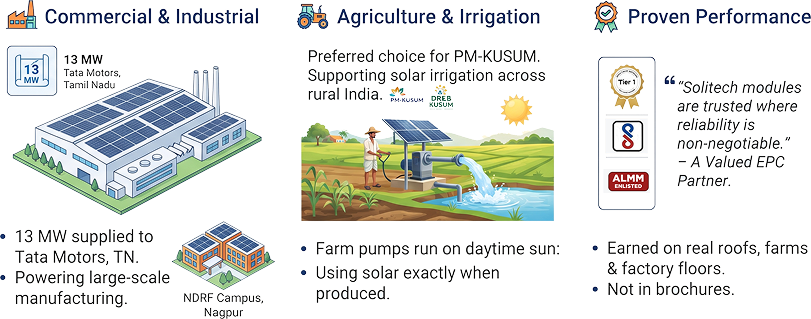
Reputation in this business is earned on real roofs, farms and factory floors, not in brochures. Solitech modules supplied roughly 13 MW at a Tata Motors plant in Tamil Nadu and went into the NDRF campus in Nagpur. In agriculture, Solitech is a preferred name for PM-KUSUM installations, with significant supply for DREB KUSUM projects. Farm pumps run on daytime sun, which makes them a clean example of using solar exactly when it is produced.

Proven Where Power Matters

Reliability Beyond the Panel

Supply security matters as much as efficiency. Solitech’s wide distribution network supports easy availability and faster deliveries, while dedicated technical support and fast warranty assistance, on top of a 30-year warranty, help plants keep generating. Smart monitoring solutions add real-time insight into generation. For C&I users, high-efficiency modules mean more daytime power and less reliance on a strained grid. Residential rooftop owners benefit too, through high efficiency, better aesthetics and long-term savings. Solitech is also planning to enter ingot and wafer manufacturing, which should tighten supply chain control and support India’s self-reliance in solar.

Conclusion

The evening gap will not close overnight. India does not need to choose between more solar and a stable evening supply. It needs both, along with storage that is still catching up. Until then, the most reliable step is making sure every daytime unit is fully delivered. If you are an EPC, developer or distributor planning your next project, speak with the Solitech Solar team about modules built for that job.

Frequently Asked Questions

Why does India face power shortages despite more solar?

Solar produces in the daytime while peak demand comes after sunset. With limited battery storage, surplus daytime power cannot easily shift to the evening, so other sources must cover it.

Is Solitech Solar a good manufacturer?

Solitech is a Gujarat-based manufacturer, ALMM enlisted and BIS certified, using automated lines with German technology. Its modules supplied roughly 13 MW at a Tata Motors plant in Tamil Nadu.

Does Solitech Solar supply batteries or installations?

No. Solitech manufactures solar modules. Storage and installation are handled by developers, installers and EPC partners.

Are Solitech modules suitable for PM-KUSUM?

Yes. Solitech is a preferred brand for PM-KUSUM installations, with extensive participation in agricultural solar pump projects and significant DREB KUSUM supply.

Are Solitech modules ALMM listed?

Yes. They are ALMM enlisted and BIS certified, making them eligible for government and institutional projects.

What support does Solitech Solar offer?

Dedicated technical support, fast warranty assistance, dealer support and responsive after-sales service, backed by a wide distribution network across India.

Related Blog

When Quality Becomes the New Currency Solitech Solar and the ALMM 2026 Shift

When Quality Becomes the New Currency: Solitech Solar and the ALMM 2026 Shift

There’s a quiet but significant change happening across India’s solar industry – and it doesn’t show up loudly in headlines. It shows up when a commercial buyer starts asking for module datasheets before asking for price. It shows up when a factory owner in Surat or a housing society in Pune calls a manufacturer not to negotiate a discount, but to ask how long the panels will actually last.

Read More...
The Future of Solar Panels 8 Breakthrough Technologies Shaping Solar by 2030

The Future of Solar Panels: 8 Breakthrough Technologies Shaping Solar by 2030

The solar industry is changing faster than most buyers realize. New cell technologies, smarter manufacturing, and better quality standards are reshaping what a “good” solar panel even means. For homeowners, EPC companies, and distributors alike, understanding where the industry is headed – and choosing a manufacturer already building for it – is becoming just as important as comparing price per watt.

Read More...